Wednesday, February 01, 2006

Street rights and the Commonwealth Games


The Homeless Person's Legal Clinic at PILCH has put out a special newsletter (Word document) about people's rights when dealing with police, security guards and ticket inspectors during the Melbourne Commonwealth Games.
(Before the Olympics in Atlanta, and later Sydney, there were big capaigns to 'clean up' by getting rid of the street people, and something similar appears to be going on here in Melbourne.)

, , , , , , ,

Cricket

Today I played cricket with a real cricket ball for the first time, with the Credo team. Charlesy taught me to bowl five minutes before we started fielding. We lost against Sacred Heart (St Kilda) in the morning and beat Geelong in the afternoon.

Tuesday, January 31, 2006


Yesterday the concrete people put up a thing so that we can get through the laneway. For the last two weeks it's been completely blocked off, so it's good that we don't have to use the front door all the time now. It might mean there's more people coming to inject heroin during the day as well.

Monday, January 30, 2006

Cleaning the laneway

Me and Ray cleaned the laneway for the first time this morning. The nozzle for the tap was missing. It was probably left on the tap, and taken by someone, to dissolve their heroin in.

Friday, January 27, 2006

The hordes of street evangelists

I keep getting targeted by street evangelists, trying to get me to convert to their brand of Christianism: Bible-believeing, spirit-filled, faith-healing or New Testament Christianity - the list goes on. The guy this evening was trying to tell me that people aren't saved unless they speak in tongues.
Ahhh, Melbourne!

Parables

He [Jesus] also said, 'This is what the kingdom of God is like. A man scatters seed on the ground. Night and day, whether he sleeps or gets up, the seed sprouts and grows, though he does not know how. All by itself the soil produces grain—first the stalk, then the head, then the full kernel in the head. As soon as the grain is ripe, he puts the sickle to it, because the harvest has come.'
Again he said, 'What shall we say the kingdom of God is like, or what parable shall we use to describe it? It is like a mustard seed, which is the smallest seed you plant in the ground. Yet when planted, it grows and becomes the largest of all garden plants, with such big branches that the birds of the air can perch in its shade.'
With many similar parables Jesus spoke the word to them, as much as they could understand. He did not say anything to them without using a parable. But when he was alone with his own disciples, he explained everything.
(Mark 4:24-36)
Reading this just before at Sacred Space, I wondered about whether it mattered for Jesus whether the people understood what his parables meant, and why he only explained them to his disciples. Is it necessary for us to understand what they mean?

Wednesday, January 25, 2006

How's the serenity!

When I moved in the weekend before last, the first few nights it was really difficult to get much sleep.To much background noise, particularly the fan just outside my window. And I'd get woken by the street cleaners at far too early o'clock in the morning.
After a couple of nights I got some earplugs, then I slept fine.
The last few nights I've been able to sleep fine without the earplugs, because I've gotten used to the noise.

But tonight I was planning to go to sleep early due to tiredness, due to it having been so hot today. But there's been so many people in town, making heaps of noise, because tomorrow's Australia(n Invasion) Day, so they won't have to go to work. So I haven't been able to sleep.
So I ended up going down to the Flinders Street steps to see if anyone I knew was around. There was one guy I know from Credo, sitting on the steps with two other guys I didn't recognise, so I hung around with them for a while.
So these two policemen came up to us and asked the younger one of the guys that I hadn't met before if he had any ID, because there was a Smirnoff bottle sitting next to him, and they didn't believe that he was eighteen. He gave him a Health Care Card, and they asked him what his name was, and his date of birth. He told them his name, but said he didn't know what his date of birth was. Because he wouldn't tell them his birthdate they said they'd have to arrest him for sitting on the steps (apparently against the Transport Act), although the two other guys were also sitting on the steps, and there were about a dozen other people sitting on the steps. He still wouldn't tell them, so they arrested him.
He came back about ten minutes later and told us that he'd given them his brother's Health Care Card because he was sacred of them, and thought he'd have to go to court for underage drinking. The cops came back again and the older guy that I didn't know told them the kid had given them his brother's card because he was scared. So the cops got the kid to come back into the station. They said he probably would be let off though.
I realise they probably just want to scare kids out of breaking the law, but if they hadn't tried to intimidate him he probably would've been more likely to tell the truth, although it probably still wouldn't have been likely. I don't know if what they did would just make him resent police officers and be less likely to trust them.


Tuesday, January 24, 2006

Advocacy: social justice in Deuteronomy

Last Tuesday morning, after we looked at the passage in Leviticus, we looked at the fifteenth chapter of Deuteronomy, which was Moses' last speech before he died. It covers a lot of similar stuff to the Levicticus passage.
Some other stuff I noticed in this passage though, is that Moses doesn't tell the Israelites not to make money by lending to other countries. I suppose that might've been so that other countries who wouldn't be generous in return wouldn't be able to abuse the Israelite economic system. Dunno what I think about it though.
Another thing I noticed is that their slavery system seems a lot different to how Africans were enslaved to work in North America, or how Pacific Islanders were enslaved to work in Australia. Slaves had to be freed in the Jubilee year, and they had to be paid for the time they'd spent working for their masters. (12-18)

Monday, January 23, 2006

A little bird


This baby sparrow was sitting in one of the flower boxes out the front of Town Hall this evening, when me and Nomes stopped to ... admire ... the parsley that's there at the moment.

Sunday, January 22, 2006

The laneway - whose space?


Tuesday afternoon we had a discussion about the laneway, and whose space it is. A lot of people use the laneway. The staff of Collins Street Baptist church park there. This morning most of the church people came in through the laneway. Last weekend we (the Urban Seed residents) moved all our stuff in via the laneway. Three days a week we'll be cleaning it up. Heroin users go to the steps at the back of the Victoria Hotel, just next to our garage, to inject. Foot Patrol come into the laneway every morning to empty the fit bin. People come into Credo lunches via the laneway. Green Collect (particularly EcoPaul) use the laneway a lot, because they keep their compost and recycling bins in the garage. Staff from the Vic's restaurant come out into the laneway for smoke breaks. As of last week a team from Sydney have set up scaffolding, so they can spend the next six months repairing the Vic's 'concrete cancer'. And during the Commonwealth Games there'll be a lot of police and security services around, because the Vic will be part of the International Village.
So the laneway is very much a shared space, between a lot of different groups.

We had a look at the final chapter of the letter to the Hebrews.
The author encourages the Jewish Christians to offer hospitality to strangers (1-3). The laneway is a place where we have an opportunity to do this, by keeping it clean and well lit, in order to minimise the harm of injecting drugs. It's also a half-way point between the street and the building, a kind of neutral ground where we can meet people from the street culture, and gain each others trust enough to venture into each others' spaces, such as our living room or the Flinders Street steps, where a lot of street people congregate.
The author also talks about how he (or she) doesn't consider him(or her)self to be part of the city, but is in fact looking forward to the new city that God is reconstructing (14). The laneway has the potential to be a gateway to God's city. I was talking today to someone who comes to Credo a lot, and he said, 'The thing I like about Credo is that the worst of enemies can come and eat together, and have a civilised conversation.' Sounded like God's city, and reminded me of what Isaiah prophecies about God's kingdom:

The cattle will graze among bears. Cubs and calves will lie down together. And lions will eat grass as the livestock do.
(Isaiah 11:6)

Friday, January 20, 2006

Advocacy: social justice in Leviticus

Tuesday morning we talked a fair bit about advocacy and social justice and stuff, and looked a bit at what the scriptures say about these things.

First we looked at chapter 25 of Leviticus, which was the ancient Israelites' law book. Here's some interesting stuff we noticed:

  • Every seven years there was a complete holiday, not just so the people could have a rest, but also for the land. (1-7)
  • Every fifty years (so, once a generation) the land had to be redistributed to it's traditional owners. Each generation would have gotten a new start, so there wouldn't have been as much opportunity for generational poverty to develop, like it has in Australian society. (8-13) Debts also had to be cleared every fifty years. (25-31)
  • The land isn't understood as being the people's property, but more like a loan from God. (23-24) Reminds me that the indigenous Australians didn't traditionally believe that they owned the land that supported them.
  • Poor people had to be supported by everyone else, and weren't to be charged interest if they got into debt. (35-38)
Tell me if you come up with anything else. Any thoughts on the slavery bits? (39-53)

'The heroin guilt trip'

THE tragic case of Nguyen Tuong Van has generated much debate about the appropriateness of capital punishment for heroin traffickers. His execution in Singapore late last year was felt by many to be appropriate because, as one columnist put it: "Heroin makes people do bad things to themselves and to others. We must ensure people don't use it."

But is it really the restriction of supply, through prohibition, that prevents the disintegration of society as we know it?
Read the whole article here.
Props to Mark.

Wednesday, January 18, 2006

Moved in

Okay, so now we've all moved into Urban Seed. The last few days we've been doing training on stuff like adovocacy, referring people to various welfare organisations, responding to an overdose, cleaning up the laneway. This afternoon we also had a discussion about the theology behind cleaning up the laneway. Last night I saw and held a baby who had been born that day, in the same hospital I was born twenty-two years and twelve days previous. Tomorrow we (the residents) are going down to Queenscliff for a couple of days of camping. I'll blog more about what we've been learning when we get back. For now, here's some pictures of my room:

Friday, January 13, 2006

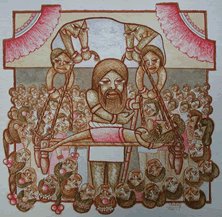
Through the roof


Picture from 'What makes Jesus Christ so unique?'
Been reading the story where Jesus heals a paralysed man (Mark 2:1-12).

A few days later, when Jesus again entered Capernaum, the people heard that he had come home. So many gathered that there was no room left, not even outside the door, and he preached the word to them. Some men came, bringing to him a paralytic, carried by four of them. Since they could not get him to Jesus because of the crowd, they made an opening in the roof above Jesus and, after digging through it, lowered the mat the paralyzed man was lying on.
(Mark 2:1-4)
A couple of things surprise me about this story.
A lot of the time we Christians talk about 'coming to Jesus' as being a personal decision, or the initiation of 'a personal relationship with your Lord and Saviour'. The thing is, in this story, the sick guy is completely dependent on is friends to get him to Jesus so he can be healed.
Another thing I realised is that it would've taken a lot of guts for his friends to break through the roof. I'm sure the people inside wouldn't have been happy with bits of roof falling in on their heads. And the owner of the house mighn't have appreciated the new sky-light.

Thursday, January 12, 2006

Back from Warrnambool

Got back from Warrnambool yesterday afternoon.
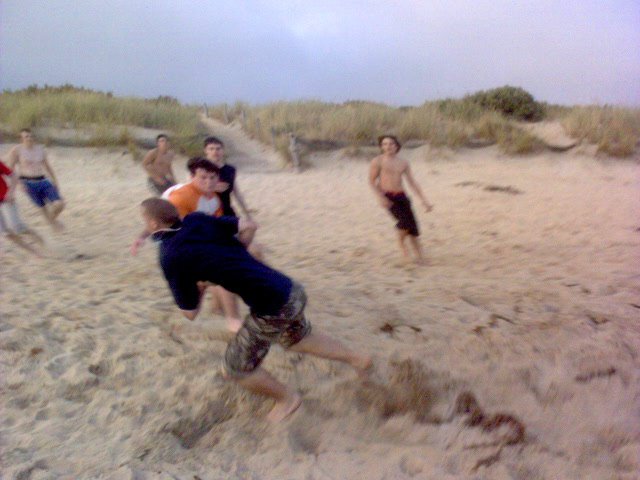
When I got there on Monday, the Ignite team were down at the beach running games of cricket and volleyball and rugby. Here's some photos from the rugby:
(They look really weird, because my phone's not meant for taking photos of people running around.)


Went and visited the Champion City (what used to be called SUFM) team after that. They have a new tradition that if someone says a particular word, they have to do ten push-ups. Rachel kept trying to trick me into saying it, so eventually I just thought that whenever she talked to me she was trying to get me to say the word.
This guy called Elliot, who was in the Universe group I was leading at the start of last year, and who has flouro yellow hair, has started another new tradition, of getting up at 6am for an extra prayer meeting.

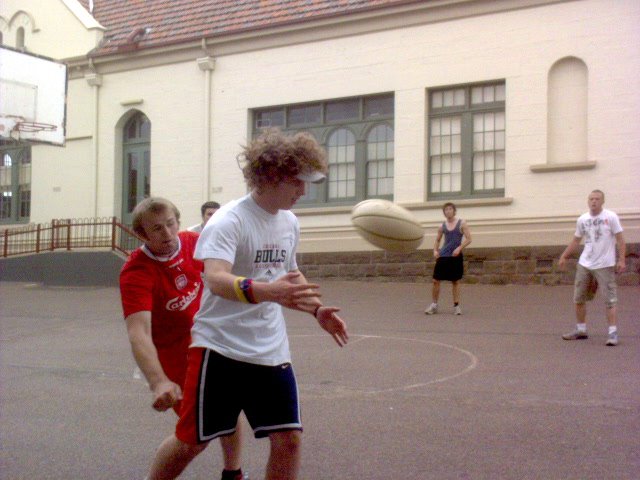
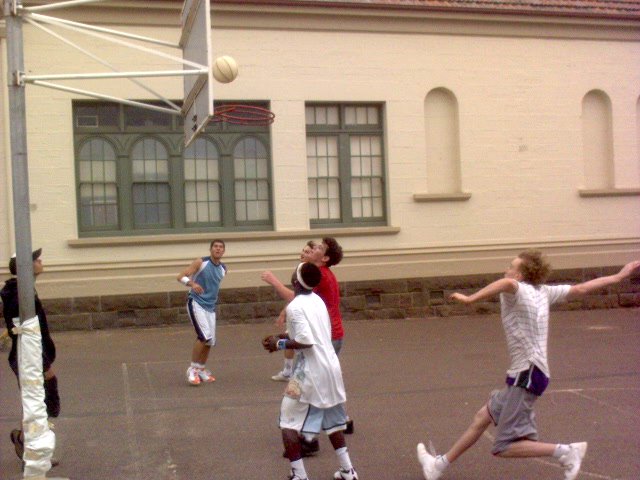
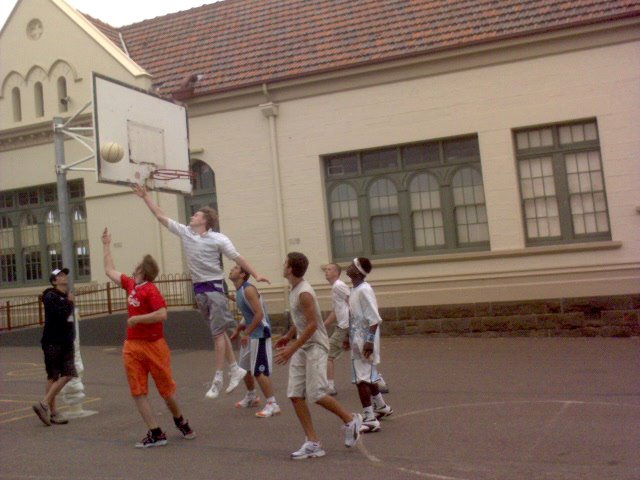
Thursday afternoon Ignite ran a three-on-three basketball tournament at Jamieson Street Primary School. They got some guys from the Warrnambool Seahawks to come and ref. Here's some photos:
(These ones are funnier, because some of the players look all stretchy.)

Sunday, January 08, 2006

Going to Warrnambool

I'm going to Warrnambool tomorrow morning to visit the Scripture Union team there. Trav's been blogging about what's been going on there. I'll be back Wednesday. On Saturday I move to Urban Seed.

Thursday, January 05, 2006

This is what I looked like twenty-two years ago, the day I was born:

Wednesday, January 04, 2006

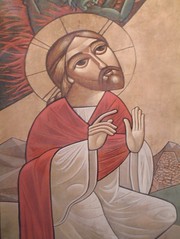
Epiphany


6th Century Italian mosaic

Epiphany is on Friday, so I’ve been reading over the story of the magi coming to visit Jesus (Matthew 2:1-12).
According to The People's New Testament, magi were 'an order of priests and philosophers which belonged originally to Persia and Media, and who were extensively distributed over the region of the Euphrates. Those described in the book of Daniel as wise men, astrologers and magicians, belonged to this order.'
I find it interesting that these foreigners, who likely practise magic and astrology, appear to be the only people in Jerusalem who realise that Messiah has been born. Even when King Herod asks the religious leaders about the expected conditions of Messiah’s arrival it doesn’t seem to occur to them that Messiah may have just been born.

King Kong


Went and saw Peter Jackson's remake of King Kong this afternoon (Tuesday).
My friend James, who I went to see it with reckoned it was to long, and that it took too long for them to the island and for Kong to come into the story. I didn't mind that though.
During one a scenes depicting a violent encounter between Carl Denham (Jack Black)'s film crew and the indigenous people of the island, I wondered how the story would differ if it was told from the point of view of the indigenouse people, who know they must sacrifice someone (preferabley not from their tribe) to appease Kong, but are also afraid of the strangers' guns.
At one point in the film several characters are attacked by what seem to be giant wetas - primative crickets from New Zealand, which Peter Jackson's special effects company is named after.

Saturday, December 31, 2005

December photos

Just uploaded a heap of photos that I've taken on my phone over the last month:


,

Friday, December 30, 2005

Jesus gets famous

Thursday night was reading the first chapter of Mark's gospel, where Jesus first starts getting famous.

Just then a man in their synagogue who was possessed by an evil spirit cried out, 'What do you want with us, Jesus of Nazareth? Have you come to destroy us? I know who you are—the Holy One of God!'
'Be quiet!' said Jesus sternly. 'Come out of him!' The evil spirit shook the man violently and came out of him with a shriek.
(Mark 1:23-26)
One thing that surprised me about this ^ bit in particular was that someone with a demon in them (whether that means he was literally possessed by a bad spirit or if it was some kind of biological illness) was actually allowed into the synagogue, and whether everyone knew he had a demon in him. And I suppose it was lucky he was allowed in, because otherwise he wouldn't have been healed.

Another thing that I noticed throughout the chapter is how Jesus responded to his new popularity. After the exorcism in the synagogue, it seems Jesus was swamped with people who wanted to be healed (29-34). But rather than taking the show to the big city, he goes out into the country for some time out, and then does a regional tour:
Very early in the morning, while it was still dark, Jesus got up, left the house and went off to a solitary place, where he prayed. Simon and his companions went to look for him, and when they found him, they exclaimed: 'Everyone is looking for you!'
Jesus replied, 'Let us go somewhere else—to the nearby villages—so I can preach there also. That is why I have come.' So he traveled throughout Galilee, preaching in their synagogues and driving out demons.

Friday, December 16, 2005

Counter SMS campaigns

Kitty sent me this on Wednesday morning:

C mon Melbourne lets spread the message that Aussies of middle eastern appearance ARE welcome here!
forward.
I forwarded it on, then realised half the people I sent it to were actually in the Western district, or interstate. By the time I had gotten to work one of the people had already sent it on to one of my workmates whose number I didn't have myself.
Also, just read about this:

$11.5 billion surplus

Okay, so the federal government has an $11.5 billion surplus for the year. (They budgeted for a $9 billion surplus.) What do you reckon they should do with all that money?

Tuesday, December 13, 2005

We don't have a racism problem!

John Howard said yesterday 'I do not accept that there is underlying racism in this country.'. Lucky he said that, otherwise I would've had the wool pulled over my eyes, good and proper.
In case you're in a different country and haven't heard about it, the weekend before last some Australians, who looked Middle-Eastern, bashed some lifeguards at Cronulla beach, in Sydney.
During the week text messages were sent between Australians of Caucasian ancestry, telling each other to take revenge against 'Lebs and Wogs'.
At least 5000 Caucasians turned up at the beach on Sunday. Various white-supremacist organisations were present, including the Patriotic Youth League. Many had t-shirts saying things like 'Wog Free Zone' and 'Ethnic Cleansing Unit'.
They assaulted several people who looked Middle-Eastern or Southern-European. They also attacked police and ambulance officers who were trying to get Australians of Middle-Eastern and Southern-European appearance out of the area safely.
Luke Connors from the Patriotic Youth League said, 'I have had people calling me all through yesterday, and today, and all through the night, just asking me when Melbourne is going to erupt in riots because they want to go and join in.'
And all this time they've been trying to get us worried about terrorists of Middle-Eastern origin.
But I'm glad the PM has cleared everything up. I was worried for a moment.

Monday, December 12, 2005

Boronia Fair Trade Concert

Yesterday was the third Make Poverty History day for the year, which was to influence the World Trade Organisation while they meet in Hong Kong this week. At the Arboretum (Boronia's version of Lake Wendouree) we had a concert and a fair trade market. People could buy shoes, soccer balls, coffee, tea and jewellery that was made by people in developing countries who were actually paid a decent wage. For a while I looked after the Tear stall, where people could buy stuff like text books, goats and clean water for people overseas. (Their gift catalogue is here.)

Towards the end of the concert, John Smith talked a bit about Santa Claus, and how the original Santa Claus wasn't much like the jolly fat man we have these days. Saint Nicholas was actually a rather affluent man who gave up his wealth to help aleviate poverty.
He also talked about how it's pretty easy to give to a charity at Christmas to make us feel good about ourselves, after a year of self indulgence. It's a lot more challenging to change the way we live, particularly the way we use our wealth, from day to day.

Wednesday, December 07, 2005

I am not interested in a free holiday

About a week ago now I had an American telemarketer call me up and ask if I was interested in a free holiday. I said I wasn't. She sounded like she couldn't believe it: 'You don't want a free holiday?!'
I said, 'Not interested! Not interested! Not interested!'
She asked how old I was.
I said, 'NOT INTERESTED, TWENTY-ONE, GOODBYE!'
Next time I think I will say something rather ridiculous.

Train surfing

Sunday night, on the train back to Ferntree Gully there was this guy I have seen before, who has a Public Enemy tatoo on the back of his shaved head and caribiners through his ear lobes. Seen him dancing and doing handstands on the train before.
Anyway, this time he got in between two of the carriages and climbed up on top of the train. When we came into the next station the train cops chased him.

I have a phone again

Same number. If you don't have it anymore, ask me.

U2 ticket

Monday morning I got a ticket to see U2 in March. Hurrah.

Concerning Wolfmother

I would just like to say that I met the frontman from Wolfmother earlier in the year, before anyone had heard of them. Can't remember his name though.

'Success'

I guess it depends how you measure success,
I can still breathe I am still blessed,
I guess it depends how measure success,
‘cause all these possessions just don’t impress
Just heard this song, by The Winnie Coopers, on Triple J. (Heard it before, but didn't catch who it was.) Full lyrics are here, and if you sign up for their newsletter here you can download it for free.

Tuesday, November 29, 2005

Talking about politics

On the weekend there was a local election here. I didn't vote because I haven't been here long enough to re-enrol. But I talked to a few of my high school friends about who they voted for and why. I also asked a baby boomer about who they voted for, and they got upset.
I was brought up not to talk about politics or about who people vote for, but most of the people I'm around these days talk about all this openly, so I think it must be a generational difference.
So do you think it's okay to talk about politics, or to talk to someone about who they (or you) voted for?
I was also wondering if there are any laws about it.

'Prisoner of Narnia'

This article from The New Yorker, about C.S. Lewis and his Narnia books makes and interesting point:

The moral force of the Christian story is that the lions are all on the other side. If we had, say, a donkey, a seemingly uninspiring animal from an obscure corner of Narnia, raised as an uncouth and low-caste beast of burden, rallying the mice and rats and weasels and vultures and all the other unclean animals, and then being killed by the lions in as humiliating a manner as possible—a donkey who reemerges, to the shock even of his disciples and devotees, as the king of all creation—now, that would be a Christian allegory.
Props to Neil Gaiman.

Going Postal


Yesterday afternoon I was at the library reading Thud! and remembered that I never blogged about Going Postal, which I read a few months ago. Both books are from Terry Pratchett's Discworld series, which I suppose is satirical fantasy.
In Going Postal Moist von Lipwig, a conman, is convicted to death. However, Lord Vetinari, the Patrician of Ankh-Morpork, gives him an opportunity to start a new life as the manager of the city's dormant and possibly redundant postal service. While trying to revive the postal service he realises how much his crimes affected other people. He also discovers how far the Grand Trunk clacks (semaphore) company will go to make sure the postal service doesn't make a come-back.

Friday, November 25, 2005

Job


I've been reading the book of Job over the last couple of weeks. Finished it this morning.
The book of Job is a really long poem, with prose bits at the start and finish.
In the first prose bit, YHWH is talking to Satan about Job, and what a good person Job is. Satan says that Job is only a good person because he is filthy rich, rather healthy for his age and has a model family. So YHWH makes a bet with Satan, that if Satan takes away Job's wealth, health and children, Job will still be a good person.
The poem it basically Job asking why YHWH has let his children to be killed, and him to become poor and sick. His friends tell him that it must be because he's not really as good as everyone thought, or that perhaps YHWH doesn't even care what happens to insignificant human beings. One of Job's friends, Elihu, says,

Bear with me a little longer and I will show you
that there is more to be said in God's behalf.
I get my knowledge from afar;
I will ascribe justice to my Maker.
Be assured that my words are not false;
one perfect in knowledge is with you.
(Job 36:2-4)
Seems a lot like hubris. Elihu seems to reckon that he is absolutely right about everything, which (from my experience) is just asking for trouble.
Eventually YHWH himself actually turns up. He doesn't really answer Job's questions, but asks Job about where he was when the world was created, and other tricky questions about how the world works. This is one of my favorite bits:
The wings of the ostrich flap joyfully,
but they cannot compare with the pinions and feathers of the stork.
She lays her eggs on the ground
and lets them warm in the sand,
unmindful that a foot may crush them,
that some wild animal may trample them.
She treats her young harshly, as if they were not hers;
she cares not that her labor was in vain,
for God did not endow her with wisdom
or give her a share of good sense.
Yet when she spreads her feathers to run,
she laughs at horse and rider.
(Job 39:13-18)
YHWH points out to Job and his friends the unlikeliness of an animal like the ostrich being sustainable. Perhaps YHWH is pointing out that he is involved with the world, refuting Job's friends' assertions that God is not interested in the problems of human beings?
In the end YHWH says that Job was right, and that he didn't deserve what he endured.

Thursday, November 24, 2005

Star language

Monday night I watched Speaking in Tongues (John Safran and Father Bob's new current affairs/spiritual/talk show). Their first guest was Solreta Antaria, an Indigo Child. They believe that some people these days are psychically evolved, and can communicate with each other using 'star language'. So they got her to say some stuff in star language, and if anyone thought they understood it, they were supposed to email their translation in. It sounded a lot like how a lot of Pentecostals sound when they speak in tongues.

Nauru House

I have a job now! At Sean's party my friend Jess said that her dad is always looking for more cleaners. So on Monday I called him up. He got back to me Tuesday night and asked if I could come in to Nauru House and work yesterday.

The Nauruan government build Nauru House as an investment when they realised that their superphosphate was going to run out.
The whole island of Nauru is made of superphosphate, which is baiscally fossilised bird crap, and is very good for making fertiliser. So for ages Nauru sold it's superphosphate to Australia, and was a really really rich country.
When the superphosphat started to run out they made heaps of investments in important cities, like Batmania. When Nauru House was built in the '70s it was Batmania's tallest building. And they bought 80 Collins Street and knocked it down, so they could say that Nauru House was at 80 Collins Street. It was octagonal, and there was a great big pillar of superphosphate out the front.
Nauru's economy got stuffed up in the '90s, and in recent years they're been asking Australia for a homeland, because their's will be underwater before long, due to global warming.

Anyway, yesterday I was at 80 Collins Street cleaning up one of the floors where all the interior walls had beed demolished. There's no work today, but there probably will be tomorrow. Once I start at Urban Seed I'll just be cleaning an office block in Syndal, on weekends.

Monday, November 21, 2005

Getting to Sean's 21st

Sean’s 21st was Saturday night. But I lost my invitation. I remembered that it was going to be somewhere in Sydenham (on the western edge of Batmania), at his parents’ house. So I got the phone book and found all the entries for Sean’s last name that where in Sydenham. There were only three, so I called them all up. The first two said I had the wrong number, and the third didn’t answer. So I decided to catch the train to Sydenham and hope there was someone else on the train that was going to the party.
So I caught the train into the city, and then got on the Sydenham train. At Footscray this group of about ten teenage guys and girls were getting off. Another group of three guys were getting on and they got into a fight, which lasted until the doors of the train started closing, at which point one of the guys who’d gotten on the train yelled out, ‘Come down ta Sunshine an’ try that!’ Apparently one of the guys in the other group had attacked him, to get him back for hitting him over the head with a steel bar and cracking his head open.
Luckily for me, Ryan also got onto the train at that station, and he knew where the party was.

Jesus: son of God or just wise?


Smurf Jesus, originally uploaded by blese.
There's been an interesting conversation going on over at Waving or Drowning?
C.S. Lewis says something in Mere Christianity about Jesus being either the son of God, a lunatic or a demon, and there being no room for one to consider his as simply a wise teacher. Robert disagrees. He doesn't believe Jesus was the son of God, but still thinks a lot of Jesus teachings are good.
Read here.

Friday, November 18, 2005

Harry Potter and the Half-Blood Prince


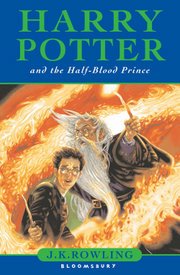
Earlier this week I read Harry Potter and the Half-Blood Prince (the most recent one). I'd been putting it off, because I'd been very disappointed with Order of the Phoenix (not much seemed to happen until the last couple of chapters), and had been told Half-Blood Prince was more of the same. But I quite liked this one.

There's an article here at Yahoo! News about the people who reckon Harry Potter encourages children to get involved in occult and pagan stuff.
And there's a pretty brief article here at Relevant, about Christian stuff in Harry Potter.

Thursday, November 17, 2005

Waking Life: André Bazin and pantheism


There's this bit in Waking Life where the protagonist is in a cinema, watching two men, who seem to be in a cafe, talking about film. One of them says,

Cinema in its essence is about an introduction to reality. It's just that reality is actually reproduced. For Bazin, its not like a story telling medium, really. He feels like literature is better for telling a story than film. You know, if you tell a story, like a joke, like this guy walks into a bar, he sees a dwarf, that works really well because you're imagining this guy and this dwarf in the bar and there's this kind of imaginative aspect to it. But in film, you don't have that because you actually are filming a specific guy, in a specific bar, with a specific dwarf, of a specific height, who looks a certain way, right? So for Bazin, what the ontology of film has to do with is also what photography has to do with, except it has this dimension of time to it, and this greater realism to it. So it's about that guy, at that moment, in that space. And you know, Bazin is a Christian, so he believes that God obviously ended up being everything, and for him reality and God are the same. So what film is actually capturing is like God incarnate, creating. And this very moment, God is manifesting as this. And what the film would capture if it was filming us right now would be like God as this table, and God as you, and God as me, and God looking the way we look right now, and saying and thinking what we're thinking right now, because we are all God manifest in that sense. So film is actually like a record of God, or the face of God, or the ever changing face of God.
André Bazin was a French film critic who believed that film should (and could) show objective reality.
I'm not sure how accurate this guy's conclusion that 'Bazin is a Christian, so he believes that God obviously ended up being everything' is, but I think this guy is touching on some interesting stuff, like the idea that everything in the world says something about God. More like panentheism than pantheism.

Waking Life index

Wednesday, November 16, 2005

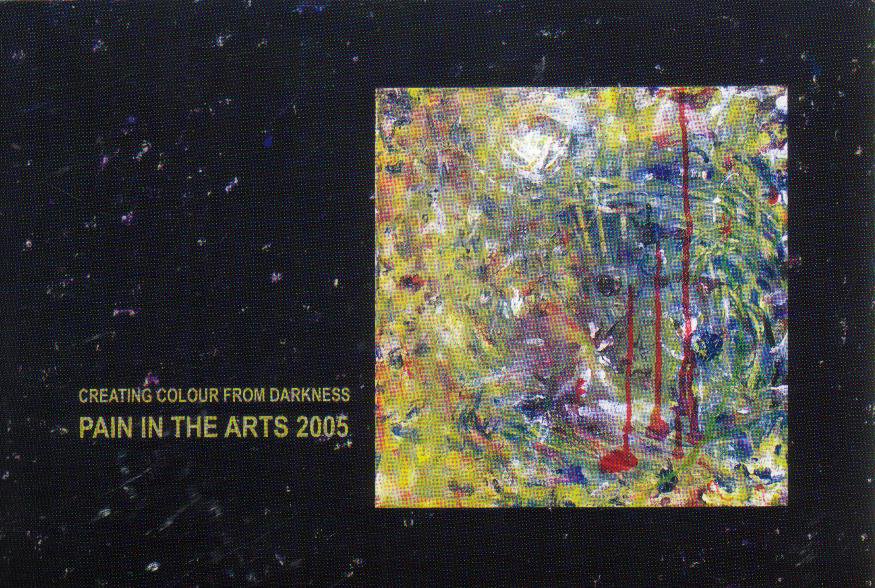
Creating Colour from Darkness


Spent most of yesterday at Urban Seed, framing the pictures for this ^ exhibition, and I'm helping set up today.
Pain in the Arts is Urban Seed's art group, that meets in Credo after lunch on Wednesdays, and at the end of each year they have an exhibition. Apparently DeeDee's dad's opening it this year.

Wednesday, November 09, 2005

Mr T gives up his chains


Mr T is going to do a reality show called I Pity The Fool where he helps people deal with fools. He says he'll more likely be wearing a suit and bow-tie than his gold chains.

"Because of the situation we're in now (after Katrina), I told myself, 'No, T, you can never wear your gold again. ' It's an insult to God."
props to Kyle

Tuesday, November 08, 2005

Esther: genocide


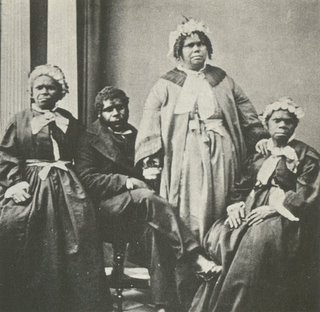
This is a picture of the last four Tasmanian Aborigines, including Truganini.

I read some more of the book of Esther on the bus to Batmania this morning.
In Chapter 2, the King starts to miss his wife (who he may or may not have had killed). So there's a beauty contest to try and find a new Queen. Esther 'wins', (Susan posted a little while ago on just how 'lucky' Esther probably was) but nobody knows that she's a Jewish exile, because Esther is a Babylonian name. (Her Jewish name was Hadassah.)

Grant Wildman from Tabor in Adelaide reckoned this was kind of like if during the war against the Aborigines someone who was part Aboriginal managed to gain a lot of influence in white society, due to the fact that they just seemed Caucasian.
(One of my friends wanted to do a theatre production based on Esther's story, and asked Grant for any ideas.)

In Chapter 3, Mordecai finds out that Haman, the King's favorite nobleman, wants to kill all the Jewish people, because Mordecai refused to bow to him. He asks the King if he can, and the King says he can.

I found it interesting what Haman said to the King to convince him:

There is a certain people dispersed and scattered among the peoples in all the provinces of your kingdom whose customs are different from those of all other people and who do not obey the king's laws; it is not in the king's best interest to tolerate them.
(Esther 3:8)
Just reminded me heaps of the paranoia toward Muslims and Arabs in Western countries since the War of Terror began.

Esther

Started reading the book of Esther the other day, including the deuterocanonical bits. (I'll post on why I've been reading the deuterocanonical books later.)
Anyway, some people reckon it shouldn't be included in the scriptures at all, some because it doesn't directly mention YHWH, and others because it's debated whether it is a historical book or a Jewish remix of a story from the Babylonian mythology. And other people don't like it because the Greek version has bits that the Hebrew version doesn't. Either way, I don't doubt that it's useful.
There's a great big elephant of an argument going on about the book of Esther it here at Wikipedia.

Anyway, so far I've read the first Septuagint bits, where Esther's relative Mordecai saves the King of Babylon from a conspiracy.
And I've read the first chapter from the Tanakh version, where the Queen doesn't do what the King says. Men all over the country start to worry that they won't be able to tell their wives what to do anymore either, so the King has the Queen executed.

Monday, November 07, 2005

Frontlines of urban education

Street Smarts is the blog of an art teacher at an inner-city public school in Celveland:

The Cleveland Municipal School District is a system fraught with the challenges inherent to a large district and an impoverished city. I am publishing this journal in response to those who are quick to criticize "those lazy, greedy, teachers". I offer you a glimpse into my world. I have always been a student of behavior. As a child, I would tame wild creatures and befriend strays. When I grew up, my natural empathy helped me become adept at observing, understanding and predicting human behavior, as well as discovering and studying what inspires and motivates people. Especially fascinating, are relationships; who we choose to associate with, and why; how we interact with one another, and how we affect each others lives.
Also, for some reason I got hits from two closely linked Cleveland blogs (Cleveland Humour and Surfing Lake Erie) yesterday, and can't work out why.

Sunday, November 06, 2005

Waking Life


I think I'm going to do a few posts about Waking Life, so this will be an index post.

free will (and intro)
existentialism
André Bazin and panentheism
, , ,

Waking Life: existentialism


Here is another monologue from Waking Life, which I think balances out the monologue from the free will post:

The reason why I refuse to take existentialism as just another French fashion or historical curiosity is that I think it has something very important to offer us for the new century. I'm afraid we're losing the real virtues of living life passionately, in the sense of taking responsibility for who you are, and the ability to make something of yourself. And feeling good about life. Existentialism is often discussed as if it's a philosophy of despair, but I think the truth is just the opposite. Sartre, once interviewed, said he never really felt a day of despair in his life. But one thing that comes out from reading these guys is not a sense of anguish about life so much as a real kind of exuberance, a feeling on top of it. It's like your life is yours to create. I've read the postmodernists with some interest, even admiration, but when I read them I always have this awful nagging feeling that something absolutely essential is getting left out. The more that you talk about a person as a social construction, or as a confluence of forces, or as fragmented or marginalized, what you do is you open up a whole new world of excuses. And when Sartre talks about responsibility, he's not talking about something abstract. He's not talking about the kind of self or soul that theologians would argue about. It's something very concrete, like you and me talking, making decisions, doing things and taking the consequences. It might be true that there are six billion people in the world and counting; nevertheless, what you do makes a difference. It makes a difference first of all in material terms, it makes a difference to other people, and it sets an example. In short, I think the message here is that we should never simply write ourselves off and see ourselves as the victim of various forces. It's always our decision who we are.
What I think is helpful here is that it isn't doubted that a person is a product of their experiences, but still points out that everybody still needs to be responsible for themselves. Sure, we don't get any choice about how we were brought up, but blaming our problems on our parents or the government isn't going to solve any of our problems.

Waking Life index

Saturday, November 05, 2005

Waking Life: free will


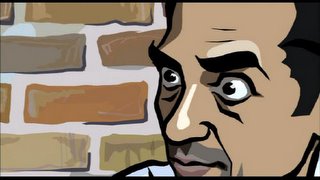
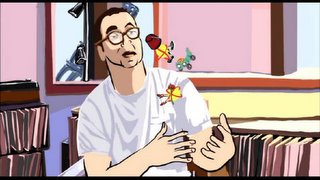
This afternoon I watched Richard Linklater (Slacker, Dazed and Confused, School of Rock)'s film Waking Life. It's about this guy who appears to be dreaming (the film's pretty surreal), and has philosphical discussions with various people.
The film is actually made up of animations, based on footage shot on digital camera. (The technique's called rotoscoping.)
One philosphical idea that is brought up is the idea of free will. This monologue sums up a lot of stuff I think needs to be considered when thinking about free will:

In a way, in our contemporary world view, it's easy to think that science has come to take the place of God. But some philosophical problems remain as troubling as ever. Take the problem of free will. This problem has been around for a long time, since before Aristotle in 350 B.C., St. Augustine, St. Thomas Aquinas, these guys all worried about how we can be free if God already knows in advance everything we're going to do. Nowadays, we know that the world operates according to some fundamental physical laws, and these laws govern the behavior of every object in the world. These laws, because they are so trustworthy, they enable incredible technological achievements. But look at yourself. We're just physical systems too, right? We're just complex arrangements of carbon molecules. We're mostly water. And our behavior isn't going to be an exception to these basic physical laws. So it starts to look like whether its God setting things up in advance, and knowing everything you're going to do, or whether it's these basic physical laws governing everything, there's not a lot of room left for freedom.

So you might try to just ignore the question, ignore the mystery of free will, and say, oh well, it's just an historical anecdote, it's sophomoric, it's a question with no answer, just forget about it. But the question keeps staring you in the face. Think about individuality for example. Who you are is mostly a matter of the free choices that you make. Or take responsibility. You can only be held responsible, you can only be found guilty, or you can only be admired and respected for things you did of your own free will. So the question keeps coming back. And we don't really have a solution to it. It starts to look like all our decisions are really just a charade.

Think about how it happens. There's some electrical activity in your brain, your neurons fire, they send a signal down into your nervous system, it passes along down into your muscle fibers, they twitch, you might reach out your arm. It looks like it's a free action on your part, but every part of that process is actually governed by physical laws, chemical laws, electrical laws, and so on.

So now it starts to look like the big bang set up the initial conditions, and the whole rest of human history, and even before, is really just the playing out of subatomic particles according to these basic fundamental physical laws. We think we're special. We think we have some kind of special dignity, but that now comes under threat. That's really challenged by this picture.

So you might be saying, well, wait a minute. What about quantum mechanics? I know enough contemporary physical theory to know it's not really like that. It's really a probabilistic theory. There's room. It's loose. It's not deterministic. And that's going to enable us to understand free will. But if you look at the detail, it's not really going to help because what happens is you have some very small quantum particles, and their behavior is apparently a bit random, they sort of swerve, their behavior is absurd in the sense that its unpredictable, and we can't understand it based on anything that came before. It just does something out of the blue according to a probabilistic framework. But is that going to help with freedom? I mean, should our freedom be just a matter of probabilities, just some random swerving in a chaotic system? That starts to seem like it's worse. I'd rather be a gear in a big deterministic physical machine than just some random swerving.

So we can't just ignore the problem. We have to find room in our contemporary world view for persons with all that that entails. Not just bodies, but persons. That means trying to solve the problem of freedom, finding room for choice and responsibility, and trying to understand individuality.
Any thoughts in response?

Waking Life index