Showing posts with label reconciliation. Show all posts

Wednesday, November 26, 2008

Illegal aliens

So we have Theresa and John staying with us this week. This afternoon John had a discussion with our staff about the implications of being foreign people in this land, and the need to either 'go back where we came from' to connect with our ancestral lands, or to connect with this land, but on the terms of it's tradition custodians. I didn't understand it that well, but I think that is okay for the moment. John connected these ideas to some of Paul's ideas:

The God who made the world and everything in it is the Lord of heaven and earth and does not live in temples built by hands. And he is not served by human hands, as if he needed anything, because he himself gives all men life and breath and everything else. From one man he made every nation of men, that they should inhabit the whole earth; and he determined the times set for them and the exact places where they should live. God did this so that men would seek him and perhaps reach out for him and find him, though he is not far from each one of us. 'For in him we live and move and have our being.' As some of your own poets have said, 'We are his offspring.' (Acts 17:24-28)
John and Theresa also ran a workshop at the Den tonight, called 'Living on Aboriginal Land'. I wasn't able to go - but anyone who did, it'd be nice to hear your thoughts.

Tuesday, November 18, 2008

'Living on Aboriginal Land'

A workshop with Baganan Kurityityin Theresa Creed and John Tracey

This workshop challenges non-Aboriginal participants to explore the relevance of concepts such as land rights, native title, sovereignty, reconciliation, treaty, self-determination, Aboriginal deaths in custody, customary law, traditional owner etc. to their own life on this country.
It explores ways in which non-Aboriginal people can support Aboriginal Australia.
The workshop offers no easy answers, only difficult questions.

6pm, Tuesday November 25th
@ “The Den” 116 Little Bourke St. Melbourne
(between Russell St. And Exhibition St. on the north side of the street)

Baganan is a Kalkadoon and Pitta Pitta woman. She was born on Woorabinda Mission and her parents were removed as children from their homelands and sent to Palm Island under the Queensland’s notorious Aboriginal protection regime. She discusses where her family come from, how they ended up in the mission system and what effect the mission system has had on her, her family and Aboriginal people in general. She presents issues such as poverty, the stolen generation, stolen wages, and cultural healing from a personal perspective. See http://treatynow.wordpress.com/

John is a non-Aboriginal Australian who has been involved in Aboriginal support work since the Land Rights protests associated with the Brisbane Commonwealth Games in 1982. John will provide an overview of White Australia’s history including the frontier wars, the protection laws and present day indigenous policy. John is a member of the “Oodgeroo of the Tribe Noonuccal, Custodian of the Land Minjerriba, Peace, Prosperity and Healing, Sacred Treaty Circles”, based on Minjerriba (Stradbroke Island). He will discuss this process as a specific model of non-Aboriginal support for Aboriginal Australia.

For more info please contact Virginia at Urban Seed v.moebusnelson@gmail.com or 9650-8034

Thursday, October 30, 2008

'Imam and pastor unite for message of peace, tolerance'


Imam Muhammed Ashafa and Pastor James Wuye are visiting Melbourne from Nigeria, to share about how they used to be militia leaders who wanted to kill each other, and are now close friends.

Pastor James Wuye lost most of his right forearm to a machete attack, and Imam Muhammed Ashafa lost family and a spiritual adviser before they met and to their surprise discovered common ground and eventually trust.
Their journey sparked the establishment of a body called the Muslim-Christian Dialogue Centre in the religiously divided city of Kaduna in predominantly Muslim northern Nigeria.
However, even the name became contentious, as Pastor Wuye recalls: "Some Christians objected that we had the Muslim name first. I told them the order did not matter."
Eventually the organisation reached out to a growing Nigerian Jewish population, as well as people of traditional animist beliefs, and evolved into the Interfaith Mediation Centre.
Read the Age article here.
(There is a documentary film about Imam Muhammed Ashafa and Pastor James Wuye, called The Imam and the Pastor.

Saturday, February 16, 2008

Desert Files - Day 9

Have been thinking more about the Sorry Day stuff. I think there needs to be a sharing of pain, because I think everyone in Australia shares the pain of not having a home. Some had their home taken from them when Britain invaded, and others lost their homes because they were sent here as prisoners, or came here for economic opportunities, or were granted asylum here. (I'm not sure how well most people can relate to that consciously though.)
I also think it's a big problem that most Australians who aren't indigenous don't even know anyone that is.

Wednesday, February 13, 2008

PM says sorry


(It's one good step in the right direction.)

Saturday, October 06, 2007

Revolution in Jesusland


Just came across a blog called Revolution in Jesusland. It's being done by a guy who's trying to encourage reconciliation between secular progressives and evangelical Christians, and showing what both of these groups can learn from each other.

Friday, April 07, 2006

Journey to the margins - part 3

Call to Follow
From the roof we go back down to earth, to street level, to the basement: Credo Cafe.
As Jesus passed along the Sea of Galilee, he saw Simon and his brother Andrew casting a net into the lake—for they were fishermen. And Jesus said to them, ‘Follow me and I will make you fish for people.’ And immediately they left their nets and followed him. As he went a little farther, he saw James son of Zebedee and his brother John, who were in their boat mending the nets. Immediately he called them; and they left their father Zebedee in the boat with the hired men, and followed him.
(Mark 1:16-20)

Jesus went out again beside the lake; the whole crowd gathered around him, and he taught them. As he was walking along, he saw Levi son of Alphaeus sitting at the tax booth, and he said to him, ‘Follow me.’ And he got up and followed him.
And as he sat at dinner in Levi’s house, many tax-collectors and sinners were also sitting with Jesus and his disciples—for there were many who followed him. When the scribes of the Pharisees saw that he was eating with sinners and tax-collectors, they said to his disciples, ‘Why does he eat with tax-collectors and sinners?’ When Jesus heard this, he said to them, ‘Those who are well have no need of a physician, but those who are sick; I have come to call not the righteous but sinners.’
(Mark 2:13-17)
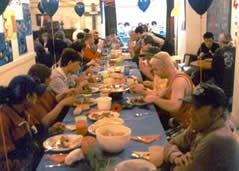
Credo was started because one of the first people that lived here was a chef, and he used to invite people he met on the street upstairs for meals. The word spread that if you knew this guy you'd get invited over for great meals, and soon there wasn't enough room in the apartment for everyone who was turning up, so the basement was cleaned up, and became Credo Cafe.
Ned, a guy who's been around Credo for a long time, said to me a couple of months ago, 'The reason I love Credo is that the worst of enemies can sit down across the table from each other and eat together.' This is kind of similar to what is going on in the scripture. The tax collectors were quite powerful people, but very unpopular because they worked for the Romans, who were occupying Israel at the time, and the sinners were people who were outcast from society because they didn't meet the religious peoples' standard of holiness, and here they are eating together. In our society lawyers have a lot of power, but aren't very popular because of the kind of work they do. Often in Credo we have lawyers and corporates from the companies that fund Urban Seed, eating alongside people who are outcast in our society because they live on the street or are addicted to drugs. Credo is a place where the powerless and the powerful can begin to be reconciled over lunch.

Friday, October 21, 2005

Enmity and friendship

'An enemy is a friend waiting to be made; that's the only hope for this conflict-ridden world.' - Desmond Tutu