advoc8
As of today I'm blogging at advoc8 as well as here.
(advoc8 is Tear Australia's site for youth and young adults.)
As of today I'm blogging at advoc8 as well as here.
(advoc8 is Tear Australia's site for youth and young adults.)
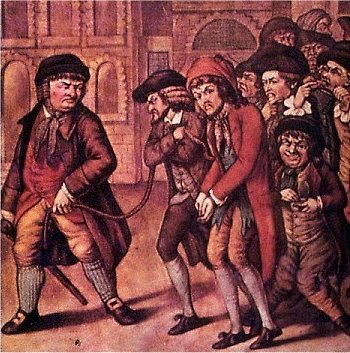
Convicts in London, about to be sent to Australia
Have been thinking about how ancient Israel's identity as liberated slaves shaped their approach to social justice. A creed they recited before offering the first part of their harvest to God says,
My father was a wandering Aramean, and he went down into Egypt with a few people and lived there and became a great nation, powerful and numerous. But the Egyptians mistreated us and made us suffer, putting us to hard labor. Then we cried out to the LORD, the God of our fathers, and the LORD heard our voice and saw our misery, toil and oppression. So the LORD brought us out of Egypt with a mighty hand and an outstretched arm, with great terror and with miraculous signs and wonders. He brought us to this place and gave us this land, a land flowing with milk and honey; and now I bring the firstfruits of the soil that you, O LORD, have given me.I seems that this had alot of influence on how the the poor and the enslaved were supposed to be treated in ancient Israel. (I wrote a bit about this in January, here and here.)
(Deuteronomy 26:5-10)
Last Tuesday morning, after we looked at the passage in Leviticus, we looked at the fifteenth chapter of Deuteronomy, which was Moses' last speech before he died. It covers a lot of similar stuff to the Levicticus passage.
Some other stuff I noticed in this passage though, is that Moses doesn't tell the Israelites not to make money by lending to other countries. I suppose that might've been so that other countries who wouldn't be generous in return wouldn't be able to abuse the Israelite economic system. Dunno what I think about it though.
Another thing I noticed is that their slavery system seems a lot different to how Africans were enslaved to work in North America, or how Pacific Islanders were enslaved to work in Australia. Slaves had to be freed in the Jubilee year, and they had to be paid for the time they'd spent working for their masters. (12-18)
Tuesday morning we talked a fair bit about advocacy and social justice and stuff, and looked a bit at what the scriptures say about these things.
First we looked at chapter 25 of Leviticus, which was the ancient Israelites' law book. Here's some interesting stuff we noticed:
'What should we do then?' the crowd asked.'Ubuntu'
John answered, 'The man with two tunics should share with him who has none, and the one who has food should do the same.'
Tax collectors also came to be baptized. 'Teacher,' they asked, 'what should we do?'
'Don't collect any more than you are required to,' he told them.
Then some soldiers asked him, 'And what should we do?'
He replied, 'Don't extort money and don't accuse people falsely — be content with your pay.'
(Luke 3:10-14)


