Showing posts with label economics. Show all posts

Wednesday, December 31, 2008

'Group moves people into foreclosed houses'


The Charlotte Observer has an interesting article about a group of activists in Miami called Take Back the Land, who are helping homeless people move into foreclosed homes:

Max Rameau delivers his sales pitch like a pro. “All tile floor!” he says during a recent showing. “And the living room, wow! It has great blinds.”
But in nearly every other respect, he is unlike any real estate agent you've ever met. He is unshaven, drives a beat-up car and wears grungy cut-off sweat pants. He also breaks into the homes he shows. And his clients don't have a dime for a down payment.
Rameau is an activist who has been executing a bailout plan of his own around Miami's empty streets: He is helping homeless people illegally move into foreclosed homes.
Read the whole article here.
(Found through Boing Boing.)

Friday, December 19, 2008

'Buy Nothing Day as Advent Activism Against the Demon Mammon'

A 34-year-old Wal-mart worker was trampled to death. A young woman miscarried in the same frenzy. Two folks were shot in the Toys-R-Us. Fights broke out in stores around the country as people stepped on each other to save $40 on a plasma TV.
Some of the media stories simply looked in horror on the crowds, calling them “savages” and such things. But there are much deeper questions we must ask. We must ask questions of class, race, inequality, and the dynamics that create killing stampedes at Wal-marts. And certainly greed may look different inside the Neiman Marcus, but that does not mean it is any less dangerous or evil.
Suddenly the theatrics don’t seem like hyperbole –- the documentaries on the “affluenza epidemic” are not so far-fetched. The antics of theological stuntsters like Rev. Billy preaching about the “Shopocalypse” and casting demons out of Wal-marts don’t seems so over-the-top. It does seem we are up against a demon … Mammon.
Read Shane Claiborne's full article here.

Friday, November 21, 2008

'Romans 1.1-25: a targum in the face of economic collapse'

Brian Walsh (co-author of Colossians Remixed, with Sylvia Keesmaat), has posted a targum (a bit like a remix) of the begining of Paul's letter to the Romans:

To all of you who live in the empire of global capitalism, to you who live at the very heart of that empire and are called out to be an alternative people: Grace to you and peace from God our Father and our Master, Jesus Christ. Grace and peace. You won’t have one without the other, and both are on offer from Jesus.
You can download the targum from Empire Remixed here.
Props to Jonny Baker.

Sunday, November 16, 2008

Andreana and Dave's blogs

Just thought I should mention two blogs that I haven't previously linked to:

Andreana has been sharing an apartment with Spriggsy and I since halfway through the year and has recently cut her hair short.

Dave moved down down to Melbourne from Sydney this year, and has been hanging around the Collins Street Baptist Church/Urban Seed mob quite a bit, and well as the Seeds folk in Footscray. He is a community development geek. And he has posted some dot points about 'The global economic meltdown of mega-doom'.

Thursday, July 24, 2008

Surrender 2008

We were at Urban Neighbours of Hope's Surrender Conference on the weekend. This is Spriggsy driving the van on EastLink when we realised we weren't going to be late for the panel that Gin was going to be on:

This is where Spriggsy, John, Jono, Mehrin and I camped:

Spriggsy, Mehrin and I were looking after the Urban Seed table. (They had this area where there were tables for mission organisations to put propaganda on.) We built a wall out of cardboard around our table, to hide it. On the outside it had images and 'beatitudes' representing what the global economy promotes as success, and on the inside (hidden, for people to find) it had the beatitudes of Jesus, along with images to represent the economy of God. (I also used the vine from State Youth Games.) Here are some pics (some from when we were still constructing):

I don't think what we did was that worthwhile, but that's okay because it's the first time we've done something like that at a conference, and I know how I'd want to do it differently next time. And someone from one of the other missions organisations (with a much bigger budget) said they wanted to copy our idea.

Friday, November 23, 2007

'No to economic refugees'

Have just been writing letters to some government ministers (Fisheries, International Affairs and Immigration) about the sixteen asylum seekers who've recently been rescued in Australian waters. They're apparently seeking asylum here because their fishing boats have been destroyed, to deter them from fishing in Australian waters, despite the fact that Indonesians were fishing near Australia long before European settlement. Kevin Andrews has said that we won't give asylum to economic refugees. Fair enough (maybe, I'm not sure) but if we're destroying their fishing boats shouldn't we at least be involved in trying to find a way they can make an income without having to break our laws?

Sunday, November 04, 2007

Another reason to avoid driving

Just been reading this article from The Age, about how a lot of people are going hungry so that we can keep driving our cars:

And if the food runs out?
“The use of food as a source of fuel may have serious implications for the demand for food if the expansion of biofuels continues,” a spokesman for the International Monetary Fund said.
The outlook is widely expected to worsen as agri-industries prepare to switch to highly profitable biofuels, according to Grain, a Barcelona-based food resources group. Its research suggests the Indian Government is committed to planting 14 million hectares with jatropha, an exotic bush from which biodiesel can be made.
Brazil intends to use 120 million hectares for biofuels, and Africa as much as 400 million hectares in the next few years. Much of the growth, the countries say, would be on unproductive land, but many millions of people are expected to be forced off the land.
Oxfam has warned the European Union that the EU policy of substituting 10 per cent of all car fuel with biofuels threatens to displace poor farmers.
The full article is here.
Any ideas about how we can decrease our dependence on cars?

Tuesday, October 30, 2007

Heroin in The Age

Yesterday The Age ran a number of articles about Afghanistan's heroin industry and the recent increase of heroin on Melbourne's streets:

Hammer horror - the curse of the streets returns
MELBOURNE is set to be caught up in an international tidal wave of high-purity Afghan heroin flooding world markets — with local addicts confirming the more lethal drug is already available on the city's streets.
The potential influx of Afghan heroin — produced from record opium crops flourishing in regions under Taliban rule — has sparked fears that Melbourne could once again become a destination for cheap, high-purity heroin as it was in the late 1990s.

A scourge woven into the fabric of Afghanistan
THE opium poppy symbolises the complexities and dilemmas confronting Afghanistan and its allies.
There are no easy answers in dealing with the crop that has made Afghanistan the world's largest opium producer, supplying 93 per cent of the illegal opium trade.
Opium cultivation accounts for 60 per cent of the Afghan economy and 90 per cent of its exports. More than three million people, 14 per cent of the population of 23 million, depend on it for their income.

Nothing but hits and memories
We cannot allow a repeat of the late '90s heroin scourge
Tragically, smack is coming back and drug experts such as Nick Crofts, from the Turning Point centre in Fitzroy, say we need to do some serious thinking about our treatment service. It is, he says, inadequate and struggling to cope with existing demand, let alone with what is yet to come. Says Dr Crofts: "We are working in a policy environment where the previous premier (Steve Bracks) said very clearly heroin is gone and the only problem we have now is amphetamines. Which is utterly wrong. State Government support for both medical treatment for people with addictions and the pharmaco-therapy program is pathetic."
A few days back it also mentioned Family First senator Steve Fielding's rebuke of the Labor Party for considering giving the Greens preferences, because of the Greens' harm minimisation policies:
'Outrage' at Greens preference deal
"It is absolutely outrageous to think that Kevin Rudd would want to preference the Greens, knowing their stance on drugs, free injecting rooms in streets, free heroin," Senator Fielding told ABC television...
...Senator Brown responded that the Greens' policies on drugs were for harm minimisation.
"Free heroin on the streets - that's absolutely wrong," he said.
"I'm a doctor. I hate drug addiction.
"But we've got to have sensible policies to meet it and we will make sensible policies."
(You can read the Greens' drug policy here.)

Wednesday, June 20, 2007

'Happiness is in your choices'

I've been reading Colossians Remixed, a book that attempts to interpret Paul's letter to the church of Colossae in it's original context, and in the context of postmodernity and the global economy.
Early on in the book the authors write about how postmodernity and globalisation work together despite seeming incompatible, because both see people primarily as 'units of consumption for whom choice is the defining characteristic.' (p32)
I came across this advertisment the other day, and I think it demonstrates this idea quite well:

Wednesday, March 07, 2007

'The Economy of God'

Cookie (currently in Aotearoa/New Zealand)'s done a post on his blog at The Age about how the Kingdom (or economy) of God differs from our globalised economy:

Whenever church clergy in Australia speak up on issues of politics or economics, the standard response from the likes of Prime Minister John Howard is that religious leaders should stay out of politics and get back into the realm of the spiritual where they belong.
Often the message from politicians is that Christian faith is only relevant to the realm of the personal and is separate from all other aspects of society - leave politics and economics to the "experts" who understand such things.
It's a reflection of a culture that has individualised and commodified spirituality, separating the "sacred" from the "secular" and ignoring the implications of Christian faith for all of human life, particularly economics.
Read the whole thing here.

Sunday, December 10, 2006

Dumpster diving

Saturday night I went dumpster diving with Barry, Ash, Ross and Pete. Barry, Ash and Ross do it all the time, and get pretty much everything they eat from dumpster diving. They basically took us on a tour of the inner northern suburbs, in the van that they live in. Barry was saying it was like being in Bangladesh, because the sky was grey from the bushfires, but the sun was so bright and hot.

The bin at the first place we went to was full of cases of pancake mix. I didn't really want any, because if I was going to make pancakes I'd prefer make them myself out of normal ingredients, rather than using a mixture that's full of preservatives and artificial flavours and stuff, but the guys insisted that I had to take some.
There wasn't any food in the next dumpster we went to, but there were an awful lot of books. I grabbed a heap of hardcover books with Korean writing on them, because I use hardcover books for making journals and sketchbooks to give to people. Also got a paperback copy of Catch 22.
Next we went to a bakery. There was a whole dumpster full of stale bread.

At the next surpermarket we went to, the dumpsters were locked, but they're pretty experienced at opening dumpsters, so we get a whole heap of lamb cutlets, lamb chops, beef steaks and kangaroo, as well as some capsicums and really big bag of pizza bread. While we were getting stuff out of the dumpster a guy and a girl came up to us because they were looking for food as well, so we said that we'd take it back to the van and divide it with them.

We all went to another supermarket across the road and it was unbeliveable how much good food they'd thrown out there. There was a watermelon, three jackfruit, heaps of potatoes, eggplant... We had to put it all in a shopping trolley.

After that we took all the stuff back to the house of the people we met, and divided up what we'd gotten, and ate the watermelon and a sponge cake with them and their housemates. We hung around there for a fair while talking about the ethics of consumption, and when we left one of them gave us a big bag of organic lemons from his mum's lemon tree.
When I got back home with my share of the food, I actually chucked a fair bit of it out again. The others had insisted that I take a whole heap of the pizza bread, and hadn't really gotten that I wouldn't be able to eat it because it's so oily and would make me feel sick. So I had to chuck that out. There was so basil, which still had roots, so I planted that in the herb garden. And there were three capsicums and ten potatoes, which I washed, and will probably cook tomorrow. And there's a loaf of sourdough bread, which I've been using.
I admire that freegans are using a whole heap of stuff that would otherwise be wasted, but I'm not sure that freeganism offers much of a long-term solution to the problem of how much food gets wasted. I think it's good that people are choosing to try and participate as little as they can in the corrupt economy (corrupt because if something isn't sold it's disposed of), but by living off the waste people are still dependant of that corruption. I think it'd probably be better for people to be using freegan tactics, but also growing their own food or consuming responsibly (eg. local and organic products).
But that's just what I reckon. What about you?

Thursday, November 23, 2006

What happened during the G20 - day 3

I got back to the embassy after the concert at about twelve thirty. There wasn't really any space left for me to lie down and go to sleep, so I just sat against the barricade. Ben turned up on his rollerblades, with two containers of rice that he'd cooked for us.
I ended up not actually sleeping, because there were so many people out.
Not long after I got there this drunk guy ran up to the barricade and started to climb over, and then jumped back down, and continued walking past, yelled a heap of abuse at us, and then got grabbed by the police and put in the back of a truck.
Another drunk guy came up to us, who I recognised from the U2 concert. He'd been standing just in front of us.
I said, 'Hey you were at the U2 show tonight, weren't ya? What'd you think?'
He said, 'Yeah, was good. Get a job ya f***in' hippy. Pay some tax.'
I told him that I already had a job and paid tax, but he was wandering off again.
We had a lot of people tell us to get jobs. Was talking to Ben about how it seemed as though people presumed that because you do something you strongly believe needs to be done, people presume that you're only doing it because you don't have a paid job, and therefore just don't have anything better to occupy your time. Also found it interesting that people think it's fine to abuse people that they believe to be unemployed.
We also had a lot of people come up to us because they genuinely wanted to talk to use and find out about why we were protesting. We had two Catholic students come up to us and say that we should've advertised what we were doing at the unis, because would've liked to have been involved. They asked wat I thought of Oscar Romero and liberation theology, and I said I didn't know much about Oscar Romero other than that he was assassinated by the Salvadoran government, but that I'd read a bit of Gustavo Guiterrez and liked what he had to say.
There were three Israeli backpackers who wanted to know where the protests had been, and whether there were any protests planned for Sunday. They asked if I was a student, and I said that I wasn't, and they asked what I did. I said that I did cleaning and I cooked food with people and did art with people and hung out with people, and explained what Credo and Urban Seed are like. Before they left one of them said, 'Isn't it great that two Jews and Muslim and a Christian can hang out and have a decent, civilised discussion?' Reminded me of the 'COEXIST' bandana that Bono used as a blindfold during 'Sunday Bloody Sunday'.
There was a couple who came up to us to ask us why we were protesting, because they didn't know very much about the G20 and wanted to find out a bit about it. I explained that the G20 was started after certain Asian and Latin American economies crashed in the '90s, so that the G8 countried could try to stablise the 'developing' economies that they depend on on for cheap resources and labour, so that their own economies would be safe as well. They said that they'd heard that the G20 were trying to alleviate poverty getting 'developing' countries to open up to foreign developers. This often means that people make more money, but also need more money. They go from having a subsistence economy, where they can produce everything they need themselves, or buy it locally, to being part of a global economy, where they are just producing masses and masses of the one item, and having to import everything else from far away. This is particularly a problem if they're producing a luxury item like coffee or tobacco. The fact that everything is produced a long way away also makes it a lot easier for companies to charge a lot more for a product than it costs them to produce the product.
Someone had a guitar, so Ben was playing it for a while, and one of the police asked if he took requests (they would've been pretty bored standing there all night), and he explained that he couldn't actually play any songs, he just made stuff up as he was going. And then he skated around in front of the barricade playing the guitar.
Later on we had a guy come to talk to us because he was offended that we had a cross and icons out in the street. For a long time he just kept saying, 'I'm mortally offended! How dare you? How dare you?' He eventually explained that he was offended because the cross and icons weren't made by someone who'd been ordained by the Roman Catholic Church. He also reckoned that you shouldn't mix religion and economics. There was another guy hanging around at that time who was a Pentecostal, and said that he could understand why he was offended, because he reckoned we looked like a cult, because we had a cross and icons, and some of us had been lighting candles earlier in the evening, to symbolise prayers.

He also reckoned we might be a cult because we looked like hippies. He said that he used to care about the environment and social justice too, but that was before he became a Christian. He said that now all that mattered was saving people's souls from Hell. He reckoned that we shouldn't protest, because converting people was more important. He reckoned we should just pray that God will change things. The Catholic guy also reckoned I wasn't a real Christian because I hadn't been baptised as a child.
At about five o'clock Ash woke up, and we watched the sun come up at five thirty. Then I went home to sleep for a few hours.
I didn't wake up until twelve. While I was asleep the police took the Credo cross away from the embassy, because they reckoned it could've been used as a missile. I think they underestimated how heavy it was, and how difficult a missile it would be to launch, because they gave it back again once they'd had enough of it.

(This is the same cross that Brent, Cookie and Jono stood with between the protesters and the mounted police during the World Economic Forum in 2000.)

When I got back to the embassy one of the protesters who'd been chanting the day before was there again, and some of the others from the embassy were chanting with him. There were also two elderly English ladies holding signs. We ended up having a discussion about the chanting, and decided to stop the chanting, because not all of us agreed with the chants, it didn't seem very peaceful, the police seemed fairly tense, and we'd found just being present and talking to people had been more productive.
We wrote a letter about why we were protesting, and when Peter Costello came down to the barricade to shake hands with the police (it was all set up for TV) we asked if he'd take it, but he ignored us. I suppose we weren't in his script.
At five o'clock I went up to the Baptist Church for their G20 church service, but I wasn't in there very long, because they guy running the service mentioned this guy called Simon who'd come in, asking for a Bible to read to the police, so I went out to see what he was doing. He was sitting on the trams tracks, against the Collins Street barricade, and screaming. I asked him what he was doing and he said he'd just arrived that day from the Gold Coast, and it'd taken him seven days to hitch to Melbourne, and he wanted me to scream at the police with him. I said I wasn't really into yelling at the cops, and told him about what we'd been doing at the embassy, and he said he'd come and join us later, if he could find us.
After the church service I went back to the embassy, and we ended the vigil with a shared meal. A lot of it was freegan stuff that the Jesus Christians had gathered.

We celebrated the eucharist using chocolate bars that the police had given us, and some cask wine. Afterwards with passed the peace with each other, the police and other activists who were still around.

I think that our public action was quite successful, in that we were able to have a good relationship with the police and with other protesters. I think we gained a lot of respect from other protesters (who are generally not too fond of Christians), particularly because we were there from Friday morning till Sunday evening. I think we were also able to get our message across fairly clearly, through the media and through direct conversations with people. Because we started on Friday we were able to actually talk about why we were protesting, which was good, because by lunchtime on Saturday all the mass media was interested in was violence.

Here's some of the media coverage we got:
'Christian pacifists demand tickets to G20' - Melbourne Indymedia
'Costello snubs Christian activists' - Melbourne Indymedia
'Christian protestors moved by police' - Melbourne Indymedia
'g20 vigil busted and moved' - Melbourne Indymedia
'Christian group in G20 tent vigil' - The Australian
'Christians, cheerleaders and lots of barricades' - The Age
'Christians kick off G20 protest' - Sydney Morning Herald
'Protesters pray ahead of G20 summit in Melbourne' - Reuters
'Protesters pray ahead of G20 summit in Melbourne' - oneindia
'JIHAD20' - Tim Blair
' 墨爾本: 廿國集團峰會墨市用鐵馬陣' - Singtao
'G20 Christians protest' - Herald Sun
'G20 Radical Christian response' - Crowlie
'More on the G20 Melbourne Christian collective' - Crowlie

Monday, November 20, 2006

What happened during the G20 - day 2

Saturday morning I found the embassy right at the bottom of Russell Street, which was where all of the cars and buses and police where entering and exiting the blockaded area.
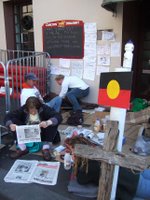
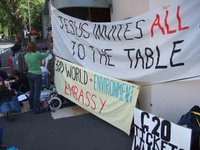
This guy called Lorian turned up, and said that he'd heard about what we were doing and wanted to join us. A couple of other protesters came and stood on the traffic island, chanting at the cars and buses that went through the gate:

Globalise justice! Not exploitation!
Globalise peace! Not war!
Globalise happiness! Not suffering!
Fair trade! Not free trade!
Power! Corrupts!
Absolute power! Corrupts absolutely!
Power to the people! Not the corporations!
We had a film with photos on it from when the police made us move, so I took it up to a newsagent in Swanston Street to get it developed. Went up to the State Library, where the march was supposed to be starting at twelve, to see what was going on. There were an awful lot of people selling Green Left and handing out flyers and stuff, which I normally find fairly irritating, so I didn't stay all that long. On the way back to the embassy, when I came to the Collins/Swanston Street intersection, there were about a hundred protesters in white suits coming down from the east end of Collins Street, and a whole heap of mounted police and riot police coming out from behind the barricades, which the protesters had managed to break through.
When I got back to the embassy, almost everyone had gone up to the State Library to join the march.

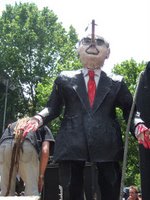
During the march Simon called us and said that the march had split up, and that it seemed like some people wanted to act violently. The officer in charge at the barricade told the officers to stake out their batons, and said something about people throwing missiles, and about driving people back to Exhibition Street.
My brother Adam turned up, because we were going to be seeing U2 in the evening. We went and checked out the Make Poverty History festival down at Alexandra Gardens. Was a bit bothered by the fact that Mount Franklin had a stall where they were selling water at $2 a bottle. I was bothered because one of the causes of poverty is companies trying to turn eveything into a commodity (eg. water, public space, communication, relationships) that has to be bought and sold.
After a while we went back to the embassy.
Late in the afternoon me and Adam and Gin decided to walk around the block and see what was going on everywhere else. (The protest was quite peaceful where we were, but Simon reckoned it didn't look good in some other places.) We had a look down Flinders Lane, and the vibe there wasn't very good at all. There was a lot of broken glass and masonry on the ground, and there were people throwing stuff in the air. (Some people reckon the glass and masonry was a set-up.) There wasn't a lot of yelling, but there were a lot of people belting out a drum beat. Apart from all the protesters against the barricade, the place was almost completely deserted, and there was no traffic. Seemed really weird, like we were in an urban warzone or something. Apparently the protesters had managed to get through the first row of barricades, and had been right up against the police, who'd driven them back with their batons. Further north, a whole heap of people had gathered in the middle of the Collins/Exhibition Street intersection, and were mostly just sitting around chatting, or playing drums, or dancing. There were a few people running around with hankerchiefs over their mouths, which seemed really irresponsible, as though they were just trying to frighten people.
After we'd finished walking round the six blocks that had been joined together by the barricades, we went to the ecumenical church service at St Paul's Cathedral. The Archbishop of Capetown, who'd visited our embassy the previous day, spoke. I was quite impressed, because he actually said that Westerners need to change the way they live, and not just ask politicians to change everything. I haven't heard anyone else from Make Poverty History point out that we need to make affluence history.
After the service we went to the U2 concert. It was kind of interesting listening to some of their lyrics after what had gone over the last two days:
I was on the outside
When they pulled the four walls down
You looked over the rubble
I was lost
I am found
('I Will Follow')

What happened during the G20 - day 1

Early Friday morning we arrived at the blockade, across the intersection from the Hyatt, outside the Gucci shop, and set up our little gazebo. (It was fairly difficult to set it up because there were so many media people getting in the way.) Then police told us that we couldn't have it in front of the shop, and that we'd have to move it into the road, in the lane that was blocked off. So we moved it over there, and we started laying down the cardboard we'd brought to sit on, and then the police told us that we couldn't have a structure, because it could block traffic. So we started dismantle the gazebo, while Jess explained in front of one of the TV cameras that the authorities had decided that the third world and the environment we're allowed to have a structure for shelter. Once we'd packed up the gazebo, the police decided they wanted us to move back onto the pavement, outside the Gucci shop.

Because there weren't many other protesters around we got a lot more media coverage than we expected, and we were able to get our message across pretty clearly, before the big protests began, and the media just started sensationalising everything. At about half past ten I got a call from Mum, who'd forgotten about what we were doing, and had gotten a surprise when she saw us on TV. We spent a lot of time talking to people about why we were protesting. We got a lot of encouragement from various anarchists who'd turned up to see if anything was happening yet. We got along quite well with the police as well. In the afternoon we had a visit from Melbourne Radical Cheerleaders.
Friday evening I had to go to work. When I got back at about midnight I was absolutely wrecked, so I didn't sleep at the embassy.
When I came outside Saturday morning the embassy was gone. Turned out that the police had woken everyone up at 3:30am and said that they were extending the barricades, and that they had five minutes to vacate the area. Three people decided they weren't going to move, so the police moved them.

Monday, November 13, 2006

What's going on during the G20?

This weekend the G20 meetings will be taking place at the Grand Hyatt, just up Collins Street from here.

There are going to be prayer vigils held on Tuesday and Thursday outside the Hyatt (Russell St entrance) from 7pm till 9pm. (Thursday's vigil is going to be held as close to the Hyatt as possible, because the barricades will have been set up by then.

Wednesday night between 7:30 and 9:30pm there's going to be a G20 Bible Study called 'Luke, Capitalism and the Kingdom of God' at the Den (our education office), 116 Little Bourke Street, Melbourne. The Den's number is (03) 9663 0699.

I'm part of A G20 Christian Collective who will be attempting to set up a Third World and Environment Ministers Embassy beside the barricades surrounding the Hyatt as a way of demonstrating the exclusion of the poor and other essential factors in the G20 meetings. We're planning to be there from Friday morning until Sunday evening. This will be a peaceful 60 hour non-stop vigil in solidarity with those who won't be represented in the meeting. Others are welcome to join us.

On Saturday from 9am till 3pm there will be a prayer and reflection space on the steps of Collins Street Baptist Church, with a sausage (and veggie burger) sizzle.

On the Saturday Stop G20 are parading a Carnival Beyond Capitalism, which will be starting at the State Library at noon.

On the Saturday, Make Poverty History is holding a festival in the Alexandra Gardens between 10am and 8pm. It will feature bands, stalls, information booths, and reflection spaces. I believe my brother Justin's going to be doing some artwork there.

Update: Justin's art demonstration at the Make Poverty History festival has been canned because it is believed that it may be seen as an endorsement of graffitti. But he might still be able to do it as part of the prayer vigil on Saturday, at the Baptist Church.

Tuesday, November 07, 2006

'Field notes from the underground'

Just read this article from the Boston Globe, about America's underground economy.

ON A COLD FEBRUARY DAY on Chicago's South Side, two men are having an argument in a church parking lot. One is a local hustler who fixes cars and does his work wherever he can. This month, he is paying a local pastor to use the church parking lot. The week before, he paid a nearby store owner to work in a back alley.
On this day, he has just fixed the car of a local resident who is not happy. His customer thought the cost to repair his rusty 1986 Cutlass Ciera was $20, but the mechanic insists that his estimate was $30.
The dispute quickly gets out of hand. The mechanic refuses to return the keys to the car. The car's owner throws the mechanic to the ground, punches him repeatedly, takes the keys and drives away in his repaired vehicle. Bloodied and angry, the mechanic pursues him.
The mechanic makes his way to his customer's apartment building, where he begins yelling for him to come out. In full view of the neighbors, as well as the local block club president, he grows frustrated, breaks into the apartment, and walks out with a TV and VCR in hand. He utters a profanity, shouts "You better believe I get my money," and marches off.
It's interesting to hear how the conflict is resolved.

Monday, August 21, 2006

The problems of bigness

Over the last month or so at Street and Hospitality Team meetings we've been discussing the fact that some days there seem to be more people coming to Credo for lunch than we can really cope with.
The lunches started about twelve years ago, when the church invited some young people to move into the building and try to connect with the church's neighbours, particularly people who were part of the street culture. One of the first residents was a chef, so they started inviting people that they met in the street to come back to their place for meals. Through word of mouth, more and more people heard about it, and it got to the point where there were so many people coming over for meals that they couldn't all fit in the apartment. So the basement of the building was cleared out, and it became Credo Café.
Credo is supposed to be not just a place where people can not just get fed, but find hospitality, a community to support them and a place where they can feel at home.
These days we're cooking enough food for sixty people, four days a week. When there were less people coming to lunch most people who were at lunch would have known each other, and when someone new turned up it wouldn't have been difficult to make sure they were welcomed. However, these days there are so many people coming in that it's not really possible for everyone to know each other, and there are often quite a few people that no one from the Street and Hospitality Team knows. With so many people it's not possible for us to spend enough time with everyone to gain their trust. With lots of people in Credo, it also gets very crowded and noisy. Because of the lack of relationships, we've also been getting quite a few people complaining if they don't like the food, or if we've run out of cordial or coffee, which isn't something you'd do if you were just over at someone's place for lunch.
So the problem is that there are a lot of people who need food, and that we are the only people in the CBD who regualrly offer a free lunch. However, with so many people coming to lunch, we're not able to sustain community as well, or offer a safe, secure place for people who don't have their own homes.
One of the things we're doing is putting together a proposal to the city council to start a service that is able to feed lots of people reguarly.
We're also thinking about how we can develop a more meaningful connection between the food that is eaten in Credo and the people who eat it, so that the meals are better appreciated. One of the ideas we have is to try and grow our own vegetables, and to involve as many people who come to lunch as we can in that.

Sunday, June 18, 2006

'...and some of the seeds fell in the path of a bulldozer...'


Just been reading some of Jesus' stories about growing crops, in Mark 4 (we had a look at some of it at church) and thinking about the South Central Los Angeles farmers who were evicted and had their crops bulldozed earlier this week.

Friday, April 07, 2006

Journey to the margins - part 2

Temptation

Next we go up onto the roof, to read from Matthew's gospel about Jesus' temptation:

Then Jesus was led up by the Spirit into the wilderness to be tempted by the devil. He fasted for forty days and forty nights, and afterwards he was famished. The tempter came and said to him, ‘If you are the Son of God, command these stones to become loaves of bread.’ But he answered, ‘It is written, “One does not live by bread alone, but by every word that comes from the mouth of God.” ’

Then the devil took him to the holy city and placed him on the pinnacle of the temple, saying to him, ‘If you are the Son of God, throw yourself down; for it is written, “He will command his angels concerning you”, and “On their hands they will bear you up, so that you will not dash your foot against a stone.” ’
Jesus said to him, ‘Again it is written, “Do not put the Lord your God to the test.” ’

Again, the devil took him to a very high mountain and showed him all the kingdoms of the world and their splendour; and he said to him, ‘All these I will give you, if you will fall down and worship me.’ Jesus said to him, ‘Away with you, Satan! for it is written, “Worship the Lord your God, and serve only him.” ’
Then the devil left him, and suddenly angels came and waited on him.
(Matthew 4:1-11)
At one point this was one of the tallest buildings in Melbourne, but now we're surrounded by much taller buildings, belonging to powerful companies like Westpac, ANZ, Optus, Commonwealth Bank and Pricewaterhouse Coopers (our wonderful sponsors). From up here it's pretty difficult to see what's going on down at street level.
In the scripture, Jesus is taken to the highest point of his capital city, where he is offered great power, but he isn't interested.

, , , , , , , ,

Wednesday, March 01, 2006

Lent

Today is Ash Wednesday, the first day of Lent. Lent is the forty days before Easter Sunday (not counting the Sundays), which is traditionally a time for 'reflection, repentance and resolve to live differently.' (That's from Mark's Lenten Reflections 06)
Been thinking a lot recently about how we can look after the God's creation, which we depend on, and are part of. So I'm going to try and go without meat for Lent, largely because it takes so much land to produce meat. Not only do livestock take up the land they live on, they also take up the land needed to grow their food. I'm also going to go without alcohol, but I don't want to be obsessive about either.