Tuesday, August 23, 2005

'Wake Up'

by Arcade Fire
from Funeral


Somethin'
Filled up
My heart
With nothin'
Someone
Told me
Not to cry

But now that
I'm older
My heart's
Colder
And I
Can
See that it's a lie

Children
Wake up
Hold your
Mistake up
Before they
Turn the
Summer into dust

If the children
Don't grow up
Our bodies get
Bigger

But
Our hearts get torn up
We're just
A million little gods causing rain storms
Turning every good thing to rust
I guess
We'll just have to adjust

With my lighning bolts a-glowin' I can see where I am going to be when
the reaper he reaches and touches my hand
With my lighning bolts a-glowin' I can see where I am goin'
Better look out below!


Originally heard this song because U2 have been playing it at the start of each show before they go on stage, and my brother Doomie has a few bootlegs.
Not sure why, but I really like it. It seems like it's mourning the results of us thinking we're gods.

How amusment

Sean has started a blog, which is quite good. Gareth and Alt Tab (as in my housemate) have also started blogs, which are quite good, but I hadn't explicitly mentioned yet. Gareth's blog is the only decent blog on MSN Spaces, and probably justifies it's existence.

Another thing I find dangerously amusing is Hydro Lite Mineral Water™. However, I do not find Hydro Lite Mineral Water™ particularly amusing because of its falvour or wetness, or even because it is particularly Lite. It's not even because each unit contains 1.4 servings. (That's right, you can use it to serve 1.4 people.)
However, it is the packaging that sets this mineral water apart from other mineral waters. It doesn't exactly come in a bottle. It doesn't exactly come in a can either. It comes in this thing that is not quite sure whether to be a bottle or a can. It is mostly like a bottle, except with the neck cut off and the top of an aluminium can stuck on the end, and that my friends (not to alienate any non-firends who may be reading) is why I choose Hydro Lite Mineral Water™.
You can get it at Coles. If you live in Melbourne, Canberra or Sydney, you can even buy it online.

Friday, August 12, 2005

Going to Melbourne

Catching the train to Melbourne in an hour. I've been really sick for the last week, and haven't been getting any better because of the weather here, and because it's been impossible to get my room warm. So I'm going to stay with my family until I get better.

Sunday, August 07, 2005

Fountain Gate is in the Bible.

Cyrus

This weekend I read Ezra, which is basically about some of the Israelites being released from exile in Persia. King Cyrus of Persia actually pays for the Temple in Jerusalem to be rebuilt (Ezra 1).
Some people think Cyrus might have had the first charter of human rights written up.

Head Beetle

Yesterday me and Trav and Craig (Trav's brother) went down to Warrnambool to talk to people who want to be involved in the Scripture Union mission there.
We were using the Presbyterian church's building, and their elder was there when we got there.
I'd met him before, so I said, 'Hi, you're the elder aren't you?'
'Yes,' he said, 'I'm the Head Beetle.'
We spent much of the day trying to work out why this guy had said he was the beetle. We even messaged Chris and asked if it was some kind of Presbyterian tradition.
Eventually we were told that he was actually the beadle, which means he has to carry this great big Bible into the chapel at the start of the church service.

Thursday, August 04, 2005

POWs

Just been reading 2 Chronicles 28. What's happened is that Israel (Samaria) has just beaten Judah in battle, and captured a lot of prisoners. However, the way they treated the prisoners doesn't seem to be the norm:

But a prophet of the LORD named Oded was there, and he went out to meet the army when it returned to Samaria. He said to them, 'Because the LORD, the God of your fathers, was angry with Judah, he gave them into your hand. But you have slaughtered them in a rage that reaches to heaven. And now you intend to make the men and women of Judah and Jerusalem your slaves. But aren't you also guilty of sins against the LORD your God? Now listen to me! Send back your fellow countrymen you have taken as prisoners, for the LORD's fierce anger rests on you.'

Then some of the leaders in Ephraim — Azariah son of Jehohanan, Berekiah son of Meshillemoth, Jehizkiah son of Shallum, and Amasa son of Hadlai — confronted those who were arriving from the war. 'You must not bring those prisoners here,' they said, 'or we will be guilty before the LORD. Do you intend to add to our sin and guilt? For our guilt is already great, and his fierce anger rests on Israel.'

So the soldiers gave up the prisoners and plunder in the presence of the officials and all the assembly. The men designated by name took the prisoners, and from the plunder they clothed all who were naked. They provided them with clothes and sandals, food and drink, and healing balm. All those who were weak they put on donkeys. So they took them back to their fellow countrymen at Jericho, the City of Palms, and returned to Samaria.
(2 Chronicles 28:9-15)

Wednesday, August 03, 2005

The soul as a garden

Someone just sent this to me in an email:

What is the spiritual battle? Well, the soul is a garden divided into two parts. On one half are planted thorny bushes, and on the other half flowers. We also have a water pump with two taps and two channels. The on guides the water to the thorns and the other to the flowers. I always have the choice to open one or the other tap. I leave the thorns without water and they dry up, I water the flowers and they blossom.
(Elder Porphyrios, Precious Vessels of the Holy Spirit - The Lives and Counsels of Contemporary Elders of Greece, p170)

The Sandman #5: A Game of You


On Sunday I read A Game of You, from Neil Gaiman's Sandman series.

Here's a page from it (click to view it full size):

What's just happened is that Thessaly (the one with the big glasses) has just summoned the Moon, who doesn't appear to be very happy.

It seems like the depiction of the Moon's been influenced by the idea that God is three but also one, with the threefold facial features, and the echoes in the central frame.

Also, when the Moon says,

You you you, need need need something thing thing from from from me me me? What have you given me? What have you done for me? Why should I do anything for you?
it reminds me of when YHWH shows up in front of Job and points out that he's far greater than Job and owes him no explanation for what Job's gone through (Job 38-41)

The Moon never catually admits to being obliged to do whatever Thessaly says. When Thessaly says, 'you are mine to disperse of, mine to command,' the Moon just says, 'Perhaps,' and warns Thessaly that her hubris will be her undoing.
I don't want to say anything about what happens later, in case it ruins it for someone who hasn't read it and wants too. So to keep reading, select the blank space below.
Because Thessaly summons the Moon, there's a hurricane, which ends up destroying the block of flats the main characters live in. Kind of like a nemesis.

Monday, August 01, 2005

'If anyone adds anything to them...'

I warn everyone who hears the words of the prophecy of this book: If anyone adds anything to them, God will add to him the plagues described in this book. And if anyone takes words away from this book of prophecy, God will take away from him his share in the tree of life and in the holy city, which are described in this book. (Revelation 22:18-19)
I've always presumed that John was warning against adding to or taking away from that particular book, Revelation, seeing as the Bible didn't exist at that stage. He appears (to me) to be speaking specifically about the book he's about to finsih writing. However, I was talking to someone the other day who reckons John is warning against adding new books to the canon, or taking books out. What do you think?

Friday, July 29, 2005

Micaiah's vision

This is what Micaiah said to Ahab (once Ahab had agreed to summon him):

I saw the LORD sitting on his throne with all the host of heaven standing on his right and on his left. And the LORD said, 'Who will entice Ahab king of Israel into attacking Ramoth Gilead and going to his death there?'
One suggested this, and another that. Finally, a spirit came forward, stood before the LORD and said, 'I will entice him.'
'By what means?' the LORD asked.

'I will go and be a lying spirit in the mouths of all his prophets,' he said.
'You will succeed in enticing him,' said the LORD. 'Go and do it.'

So now the LORD has put a lying spirit in the mouths of these prophets of yours. The LORD has decreed disaster for you.
Micaiah, 2 Chronicles 18:18-22
I don't get it. It seems to be saying, pretty blatantly, that YHWH was behind the deception of the prophets. Also, since he was trying to trick Ahab into attacking Ramoth Gilead, why did he let Micaiah know what was really going on? I suppose he knew that Ahab hated Micaiah, and wouldn't want to listen to him, but I'm still confused.

Ahab chucks a tantrum

The king of Israel answered Jehoshaphat, 'There is still one man through whom we can inquire of the LORD, but I hate him because he never prophesies anything good about me, but always bad. He is Micaiah son of Imlah.'
'The king should not say that,' Jehoshaphat replied.
(2 Chronicles 18:7)
That just cracks me up.

Thursday, July 28, 2005

Exodus

The priests and Levites from all their districts throughout Israel sided with him [King Rehoboam]. The Levites even abandoned their pasturelands and property, and came to Judah and Jerusalem because Jeroboam and his sons had rejected them as priests of the LORD. And he appointed his own priests for the high places and for the goat and calf idols he had made. Those from every tribe of Israel who set their hearts on seeking the LORD, the God of Israel, followed the Levites to Jerusalem to offer sacrifices to the LORD, the God of their fathers. They strengthened the kingdom of Judah and supported Rehoboam son of Solomon three years, walking in the ways of David and Solomon during this time. (2 Chronicles 11:13-17)
Reminds me of Christian Exodus:
ChristianExodus.org offers the opportunity to try a strategy not yet employed by Bible-believing Christians. Rather than spend resources in continued efforts to redirect the entire nation, we will redeem States one at a time. Millions of Christian conservatives are geographically spread out and diluted at the national level. Therefore, we must concentrate our numbers in a geographical region with a sovereign government we can influence through the electoral process.

Rehoboam

A couple of days ago I read 2 Chronicles 10, which is about Israel's rebellion against King Rehoboam. The people had asked him to reduce the heavy taxes Solomon had introduced. However, Rehoboam said,

My father made your yoke heavy; I will make it even heavier. My father scourged you with whips; I will scourge you with scorpions. (2 Chronicles 10:14)
It seems kind of like he's treating them just like their ancestors were treated in Egypt, when they were slaves:
Afterwards Moses and Aaron went to Pharaoh and said, 'This is what the LORD, the God of Israel, says: "Let my people go, so that they may hold a festival to me in the desert."' (Exodus 5:1)

That same day Pharaoh gave this order to the slave drivers and foremen in charge of the people: 'You are no longer to supply the people with straw for making bricks; let them go and gather their own straw. But require them to make the same number of bricks as before; don't reduce the quota. They are lazy; that is why they are crying out, "Let us go and sacrifice to our God." Make the work harder for the men so that they keep working and pay no attention to lies.' (Exodus 5:6-9)
Because Rohoboam wouldn't reduce the taxes, all the tribes of Israel, except for Judah, rebelled against Rehoboam, and made Jeroboam their king.

Wednesday, July 27, 2005

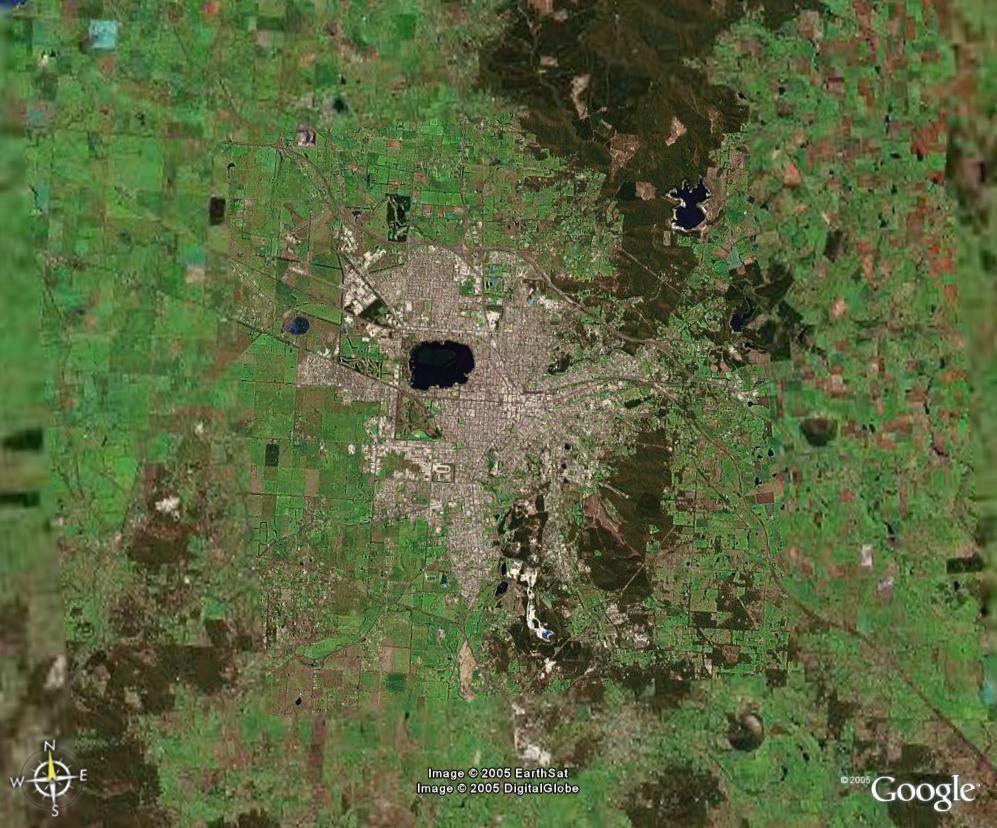
Ballarat


From Google Earth.

Monday, July 25, 2005

Solomon's request for wisdom

Last night I started reading 2 Chronicles.
What stood out to me in the first chapter was that YHWH was pleased with King Solomon's request for wisdom because he wanted it in order to serve his people well, not so he could become rich and famous or whatever.

God said to Solomon, "Since this is your heart's desire and you have not asked for wealth, riches or honor, nor for the death of your enemies, and since you have not asked for a long life but for wisdom and knowledge to govern my people over whom I have made you king, therefore wisdom and knowledge will be given you. (2 Chronicles 1:11-12)
Previously I'd gotten the impression that Solomon had had asked for the right thing, but now it seems more like he had the right motive.

Friday, July 22, 2005

King David and the Temple (part 2)

David said to Solomon: 'My son, I had it in my heart to build a house for the Name of the LORD my God. But this word of the LORD came to me: "You have shed much blood and have fought many wars. You are not to build a house for my Name, because you have shed much blood on the earth in my sight. But you will have a son who will be a man of peace and rest, and I will give him rest from all his enemies on every side. His name will be Solomon, and I will grant Israel peace and quiet during his reign. He is the one who will build a house for my Name. He will be my son, and I will be his father. And I will establish the throne of his kingdom over Israel forever."' (1 Chronicles 22:7-10)
When I was down in Warrnambool last month, some guys from one of the churches there invited me round to their place to eat pizza and watch this film about King David.
When it got to this bit, at first I thought it was a bit harsh on David, considering that YHWH aided him in battle (1 Chronicles 11:14, 14:10, 18:6, 18:13).
I have a feeling now that YHWH might not have been punishing David, as such, but that maybe David just wasn't the right person to build the Temple, same as a chainsaw isn't the right tool for banging in a nail.

King David and the Temple

I've been reading 1 Chronicles. Almost finished it.

This afternoon I was surprised to read that Nathan originally told King David that he should go ahead and build YHWH a temple, before God told him that he didn't want David to build it (17:1-6). I think Nathan would have had to be pretty humble to go back to David the next day and admit he'd been wrong.

When YHWH says:

'I have not dwelt in a house from the day I brought Israel up out of Egypt to this day. I have moved from one tent site to another, from one dwelling place to another. Wherever I have moved with all the Israelites, did I ever say to any of their leaders whom I commanded to shepherd my people, "Why have you not built me a house of cedar?"' (17:5-6)
it seems to me as though he is suggesting that he is a wild deity, and that David is (conscuiously or unconsciously) trying to contain or domesticate him.

This reminds me of one of Pro Hart's paintings, which we saw at his gallery in Broken Hill:

It's called The Search for God. I'm finding it hard to put into words why I've been reminded of this painting though.
Any ideas?

Wednesday, July 20, 2005

TERUWAH!


Picture: Return of the King

One word Paul uses to describe the fruit of the Holy Spirit is 'joy'.
One of the Hebrew words that we translate into 'joy' is 'teruwah', which is a battlecry. It's used to describe the sense of jubilation in battle:

When they make a long blast with the ram's horn and you hear the sound of the trumpet, all the people shall shout with a great shout [teruwah]; and the wall of the enclosure shall fall down in its place and the people shall go up [over it], every man straight before him.
Joshua 6:5
So the people shouted, and the trumpets were blown. When the people heard the sound of the trumpet, they raised a great shout [teruwah], and [Jericho's] wall fell down in its place, so that the [Israelites] went up into the city, every man straight before him, and they took the city.
Joshua 6:20
Upon what were the foundations of it fastened, or who laid its cornerstone,
When the morning stars sang together and all the sons of God shouted for joy [teruwah]?
Job 38:6-7
And when the ark of the covenant of the Lord came into the camp, all Israel shouted with a great shout [teruwah], so that the earth resounded.
And when the Philistines heard the noise of the shout, they said, What does this great shout [teruwah] in the camp of the Hebrews mean? When they understood that the ark of the Lord had come into the camp,
The Philistines were afraid, for they said, God has come into the camp. And they said, Woe to us! For such a thing has not happened before.
1 Samuel 4:5-7
And now shall my head be lifted up above my enemies round about me; in His tent I will offer sacrifices and shouting of joy [teruwah]; I will sing, yes, I will sing praises to the Lord.
Psalm 27:6
I realised that I've been getting sick of the spiritual battle (parituclarly against my own sexual lust) and fed up with it. Need to get back into fighting joyfully.

Monday, July 18, 2005

Broken Hill photos

These are some photos Tab and Em took. (Haven't got mine developed yet.)


This is one of the exploded tires.


This is my Best Soft Feather Heavy Breed ribbon.


This is Peter Browne's gallery, in Silverton. Silverton is a ghost town. They've shot a lot of films (Mad Max 2, Town Like Alice, Priscilla Queen of the Desert, Dirty Deeds) and ads there. It rained a lot when we were there.

Saturday, July 16, 2005

Op shopping and desert wandering

Almost everyone has gone back to Canberra or Strathalbyn or Sydney or wherever now. We're going back to Ballarat tomorrow.
This morning we went op shopping. I got two shirts, some grandpa shoes and four Everworld books for under $10.
This morning I've just been walking around in the desert taking photos (the sun's come out a lot more today).

Wednesday, July 13, 2005

Pro Hart's gallery

Apparently Broken Hill has about twenty four art galleries. Some of us went and visited four of them yesterday.

The best was Pro Hart's gallery. He has the largest private collection in Australia, including a lot of his own work, as well as some stuff by Salvador Dalí, Claude Monet and George Gittoes (my favorite Australian artist).
Pro Hart also has a sculpture park across the road from the gallery, which backs onto an old picture framing shop, where Adam (fine art student from Canberra) found a huge, gold frame, which he now has to try and get home somehow.


Pro Hart's Miner's Cricket Match

Tuesday, July 12, 2005

Broken Hill Poultry & Pigeon Club

I forgot to mention last night that I won the Broken Hill Poultry & Pigeon Club 2005 Best Soft Feather Heavy Breed award.

Explosions

Two of the tires (front right and back left) on Matt's car blew up between Avoca and St Arnaud (very early in our trip) at the same time. The RACV towed us into St Arnaud though, and we got them fixed up there. Blog more when we get back.

Saturday, July 09, 2005

Broken Hill

Me, John, Kelly and Em are leaving for Broken Hill at 6am Sunday, so I probably still won't be posting much for ages. We're visiting Tab and taking part in Discovery Week (which is to do with the fruits of the Holy Spirit) at Cornerstone.
Haven't been to Broken Hill before. I've been told it's in the desert and there are a lot of artists, so that sounds good. Apparently someone from Broken Hill won Big Brother last year, but I'm sure it can't be too bad.

Sunday, July 03, 2005

Book meme

Kitty tagged me for this meme yesterday.

Total books owned, ever:
Don't know. Probably about six-hundred. I just counted that I have eight-two at my parents house, and I've probably got about twice that at my house. Maybe I'll count them when I get back.

Last book I bought:


Last book I read:


Five Books that mean a lot to me:


Now I'm tagging Adam, Anthony, Susan and Ted.

Friday, July 01, 2005

God changes his mind?

Here's an example of on of the many things I don't understand:

In those days Hezekiah became ill and was at the point of death. The prophet Isaiah son of Amoz went to him and said, "This is what the LORD says: Put your house in order, because you are going to die; you will not recover."

Hezekiah turned his face to the wall and prayed to the LORD, "Remember, O LORD, how I have walked before you faithfully and with wholehearted devotion and have done what is good in your eyes." And Hezekiah wept bitterly.

Before Isaiah had left the middle court, the word of the LORD came to him: "Go back and tell Hezekiah, the leader of my people, 'This is what the LORD, the God of your father David, says: I have heard your prayer and seen your tears; I will heal you. On the third day from now you will go up to the temple of the LORD. I will add fifteen years to your life. And I will deliver you and this city from the hand of the king of Assyria. I will defend this city for my sake and for the sake of my servant David.' "
2 Kings 20:1-6
If God doesn't change, then why does he change his mind? Why would God chnage things because of people praying?
Maybe he intended to change his mind all along once Hezekiah had humbled himself. But if YHWH was intending to heal him all along he would have been lying to say that Hezekiah wouldn't get better.
Another idea that came to mind is, maybe God really did intend to let Hezekaih die, but was emotionally moved by Hezekiah's misery, to the point that he was willing to change his plans, even though he was in the place of authority.

ARGH!

Why does this have to happen? It's the last day that I can hand in my last essay and the computers aren't working, so I can't access my essay to finish it and even if I could, I can't print it.

Thursday, June 30, 2005

Hezekiah

In the fourteenth year of King Hezekiah's reign, King Sennacherib of Assyria came to attack the fortified cities of Judah and conquered them. King Hezekiah sent this message to the king of Assyria at Lachish: "I have done wrong. I will pay whatever tribute money you demand if you will only go away." The king of Assyria then demanded a settlement of more than eleven tons of silver and about one ton of gold. To gather this amount, King Hezekiah used all the silver stored in the Temple of the LORD and in the palace treasury. Hezekiah even stripped the gold from the doors of the LORD's Temple and from the doorposts he had overlaid with gold, and he gave it all to the Assyrian king.
2 Kings 18:13-16
I was really surprised when I read this bit. I was pretty sure Hezekiah was one of the kings that honored YHWH, and for some reason I thought YHWH wouldn't be to happy with him giving away all the Temple's silver. But it doesn't say anything about God getting angry about it, and he looked after Jerusalem all through his reign.

Stealth idols

When the Israelites were wandering in the desert, and were attacked by snakes, YHWH got Moses to make a bronze snake. Everyone who looked at it was cured of snakebite. (Numbers 21:4-8)
However, the Israelites eventually ended up worshipping the bronze snake, and King Hezekiah had to destroy it. (2 Kings 18:1-4)

It seems as though a gift or tool can become an idol, even though it's good and God has given it to us. We can end up putting our faith in these things, instead of in God, who gives them to us.
It's possible for us to idolise buildings, music, scripture, particular forms of church. In the emerging church we're just as much at risk of this. We're just as susceptible to idolising postmodernity as our predecessors were to modernity. Any ideas about how we can avoid this?

Sell-out

I've decided to start blogging stuff that stands out to me when I read scripture, to make sure that I am taking something in. So if I don't say much about what I've been finding in the scriptures, please email me and ask, because the chances are that I haven't been bothering.

Just read 2 Kings 16. I was pretty upset that the Israelites' exile started because King Ahaz let King Tillegath-pilneser of Assyria take over Damascus, in exchange for protection from Prince Pekah.
In the next chapter, Tillegath-pilneser's successor, Shalmaneser took over Samaria, so King Hoshea (Pekah's successor) asked the King of Egypt for help.
The people also tried to solve their problems by worshipping idols, through magic and by ignoring YHWH. As a result, the Israelites (except for Judah) were exiled to Assyria, and their land was resettled.
I suppose what I understand from that is that we need to depend on God before we depend on other people or on money or strategies or whatever.

Another thing I noticed was that the new settlers were given an opportunity to follow YHWH:

The king of Assyria then commanded, "Send one of the exiled priests from Samaria back to Israel. Let him teach the new residents the religious customs of the God of the land." So one of the priests who had been exiled from Samaria returned to Bethel and taught the new residents how to worship the LORD.
2 Kings 17:27-28.

21 Grams


Last night I watched Alejandro Iñárritu's 21 Grams, a film about life and death and revenge and forgiveness and redemption.
Sean Penn plays Paul Rivers, who is dying and needs a heart transplant. Benicio Del Toro plays Jack Jordan, an ex-convict who has turned to fundamentalist Christianity in order to redirect his life. Naomi Watts plays Cristina Peck, a reformed cocaine-addict.
Their stories merge when Jack runs over Cristina's husband, Michael, and Cristina allows the hospital to give Paul her husband's heart.
Jack turns himself in, and his faith is severely tested in gaol. Cristina ends up back on cocaine. Paul finds out about what it cost Cristina and Jack for him to live. He struggles with whether he should try to reconcile them or avenge Michael's death.

The title of the film comes from the experiments of Dr Duncan MacDougal, who claimed that the human body lost 21 grams at death. He rekoned this was the weight of their departing soul.* In this film, Iñárritu raises questions about the 'weight' of life, and what it is that leaves our bodies when we die. He also wrestles with questions about why people have faith and why God would allow such awful stuff to happen to people.

*Ian Sample from The Age got a bit upset about this, here. I think he missed the point.

Wednesday, June 29, 2005

'Falling at Your Feet'

by Bono and Daniel Lanois
from the soundtrack to The Million Dollar Hotel


Every chip from every cup
Every promise given up
Every reason that's not enough
Is falling, falling at your feet

Every band elastic limit
Every race when there's nothing in it
Every winner that's lost a ticket
Is falling, falling at your feet
I've come crawling, falling at your feet

Everyone who needs a friend
Every life that has no end
Every knee not ready to bend
Is falling, falling at your feet
I've come crawling, now I'm falling at your feet

All fall down All the manic dazed faces that you pull
All fall down All the action is not under your control
All fall down The graffiti rolling down off of your tongue
All fall down And the compromise you make for some

Every teenager with acne
Every face that's spoiled by beauty
Every adult tamed by duty
They're all falling at your feet

Every foot in every face
Every cop's stop who finds the grace
Every prisioner in the maze
Every hand that needs an ace
Is falling, falling at your feet
I've come crawling, and I'm falling at your feet

All fall down All the books you never read
All fall down Just started
All fall down All the meals you rushed
All fall down Never tasted

Every eye closed by a bruise
Every player who just can't lose
Every pop star hurling abuse
Every drunk back on the booze
All falling at your feet
Oh I'm falling at your feet

All fall down All the information
All fall down All the big ideas
All fall down All the radio waves
All fall down Electronic seas
All fall down How to navigate
All fall down How to simply be
All fall down To know when to wait
All fall down Explain simplicity
All fall down In whom shall I trust
All fall down And how might I be still
All fall down Teach me to surrender
Not my will, thy will


Last night we were having a look at some scriptures on humility, and I was reminded of this song. It seems to be based on Philippians 2:

Because of this, God raised him [Jesus] up to the heights of heaven and gave him a name that is above every other name, so that at the name of Jesus every knee will bow, in heaven and on earth and under the earth, and every tongue will confess that Jesus Christ is Lord, to the glory of God the Father.
Everyone and everything falls down at the feet of God. The pop star, the alcoholic, the loner, the police officer. It doesn't matter whether they realise their imperfection or not; they all fall down. The song concludes that the only way to find peace is to surrender to God, rather than trying to have our own way.

Thursday, June 23, 2005

Helping children and young people respond to God

That is what I'm supposed to be talking about Friday morning at New Life Centre's Bible school, in Warrnambool. They asked Trav to, but he can't, so he asked me to.

Our experiences of evangelism influence our understanding of evangelism. We develop the way we evangelise based on how what we have seen work or fail in other situations. What positive and negative experiences of evangelism have you had?

Scripture Union has ten principles of conversion:

Holy Spirit is responsible for conversion

'And we know that in all things God works for the good of those who love him, who have been called according to his purpose. For those God foreknew he also predestined to be conformed to the likeness of his Son, that he might be the firstborn among many brothers. And those he predestined, he also called; those he called, he also justified; those he justified, he also glorified.'
Romans 8:28-30
'No one can come to me unless the Father who sent me draws him, and I will raise him up at the last day. It is written in the Prophets: "They will all be taught by God." Everyone who listens to the Father and learns from him comes to me.'
Jesus, John 6:44-45
If it is God that brings people to himself, then what's our role?
If we can leave the responsibility of changing people to God, we can also concentrate more on our own relationships with God.

Kids are different to adults
Kids aren't able to respond to God in the same way that adults do.
For example, younger kids usually find it hard understanding abstract ideas. For example, last year when Trav was a Religious Education teacher, a lot of the kids reckoned that God was a person, a kind of superhero.
However, just because kid is unable to understand the human ideas about God doesn't mean that they can't have a relationship with God. In the scripture I quoted earlier, Jesus refers to Isaiah's prophecy:
'All your sons will be taught by the Lord,
and great will be your children's peace.'
Isaiah 54:13
This implies that God is already in a relationship with a person before they can understand him. In that case, perhaps we need to provide an environment where kids can experience God and continue to learn from him.

Darren Wight has post on this here.

We need to avoid manipulation
I think that's pretty obvious. I think this is particularly relevant in helping kids and teenagers respond to God.
Why do you think people use manipulation? Would they necessarily think they are being manipulative? Could any of our evangelistic methods be seen as manipulative?

Children are concrete thinkers
As I mentioned earlier, most kids have a hard time understanding abstract ideas. This can make it hard for them to understand the Bible, because it wasn't written for children, so it contains a lot of abstract stuff. So how do we explain the content of the Bible with kids?

Kids are part of families
Often we forget that kids are part of families, and that this has implications on conversion. For example, if a kid's parents don't want them to go to Sunday school (or whatever) there's not much the kids can do about it. Conversely, sometimes parents send their kids to the Scripture Union Family Mission program in Warrnambool even though they don't want to go.

Kids need to respond individually
It's no good if a kid decides to 'respond' simply because all of their peers do.

Relax
We need to be relaxed when helping other people respond to God. This isn't easy. It helps to remember the first principle - that it's not up to us to make someone respond to God.

Conversion is a process
A lot of the time we see God's kingdom as being like a farm with a fence. We see each person as being inside of outside the farm by whether or not they display different characteristics that we see as 'Christian'. This way of understanding God's kingdom means that we see it as our task to get people who aren't Christians onto the inside of this fence.

In the desert the farms are so big that fences aren't very useful. Instead, the farmers dig deep wells, because they know that the animals won't go to far away from their source of water.
We can look at God's kingdom like this. Instead of regarding each person as either inside or outside the kingdom, we can look at in terms of how close they are to the centre of the kingdom (Jesus) and whether they are getting closer or further away. This model acknowledges that every decision a person makes is important, as in bringing someone closer to God.

Earlier in the year I did a more in-depth post on this here.

Males should counsel males; females should counsel females
Obviously, so it doesn't look like there's anything dodgy going on.

Presume nothing
Just because someone responds in some way (at an altar call or whatever) doesn't necessarily mean they've decided they want to be a Christian. It might be that their dog died, and they want to talk to someone about it. We need to find out what they want.

Wednesday, June 22, 2005

PostSecret - confession?


Just found this blog. The reader is invited to send in a home-made postcard with a secret on it that they've never been revealed to anyone else. Some of them are published on the site.

Thursday, June 16, 2005

Dragons

This G.K. Chesterton quote is in the front of Neil Gaiman's Coraline, which I'm writing an essay about:

Fairy tales are more than true: not because they tell us that dragons exist, but because they tell us that dragons can be beaten.
Although his name sounds familiar, I don't know much about him, but he seems interesting, and appears to have been a theologian, so I think I might have to find out more about him.

Wednesday, June 15, 2005

Affective/Neutral

<< Seven dimensions of culture index
In more affective cultures it is appropriate for people to display emotions openly, and it is unnecessary for people to hide their emotions. A person from a more affective culture is likely to ignore less obvious displays for emotion them, because they appear unimportant.
This often causes conflict when a person from an affective culture encounters someone who is more accustomed to a neutral culture, because neutral cultures assume that it is wrong to show one's emotions openly. People from neutral cultures do have emotions, they are just displayed very subtly. People from neutral cultures often think that people from affective cultures are to easily excited and overly emotional, because they display their emotions more obviously. A person who displays their emotions to much will not be very highly respected.

I think mainstream Australian culture is probably more neutral than affective, but I think it's a very moderate example of a neutral culture.
One of my friends, whose family are from a Mediterranean country is always getting Caucasians telling her that she is too agressive, because she is used displaying emotions more loudly than most Caucasians are.

Do you think that your culture is more neutral or more affective? Have you ever expeienced a culture that was the oppsite?
<< Seven dimensions of culture index

Tuesday, June 14, 2005

Wilsons Promontory

Haven't posted in ages because I've had so much homework, and then I was hiking on Wilsons Promontory over the long weekend.

The ten of us stayed in Foster, at Fiona (the hike leader)'s grandma's house, on Friday night. We drove down to the Prom early Saturday morning, and set off for Five Mile Beach from the Five Mile Road carpark. It rained quite a bit at Saturday, but it had stopped by the time we got to Five Mile Beach. Me, Andre, James and George stayed set up camp at Five Mile Beach. The others decided they wanted to keep going on and camp at Johnny Souey Cove, even though they'd have to cross a lagoon at high tide, spend two hours travelling over rough, steep terrain, and it was getting dark.

Hardly slept at all that night. I did a bit though, because I had some dreams.

We met the others at Johnny Suey the next morning (we crossed the lagoon at low tide), and then we walked along the beach to Three Mile Point. From there we set out through the bush toward Three Mile Beach. The track was pretty ellusive, so we got lost, and ended up bush-bashing our way to the rocky coast, and rock-hopping the rest of the way to Three Mile Beach. I suggested that it would be easier to get back to Johnny Suey by rockhopping, so me and Andre and Fiona went back that way.

The second night we all camped at Five Mile Beach. There were these other people staying there, a guy and his son, so we got them to come and have tea with us because Suzie had cooked way to much food. There was an old couple staying there too, but whenever we tried to talk to the they just went, 'Hmph! Hmph!' and told us where our campsite was.

Yesterday we packed up all our stuff and walked back to the Five Mile Road carpark. We drove to Fiona and Caroline's parents farm, near Fish Creek, where Malcom had a conversation with their mum in New Zealish and Australian accented Japanese and the rest of us drank tea. Then we went back through Gippsland and Melbourne, to Ballarat.

Blog tree


Thought I'd made a blog tree. Admittedly, some of these blogs have only two posts. Please tell me if I've missed anyone, or if I've mixed up who got who to start blogging.
Saturday, June 04, 2005

Specific/Diffuse (part 2)

<< Seven dimensions of culture index
Specific/diffuse is hard to understand, so I'm putting together an example. Tab said about Broken Hill,

It's hard to get in (to the native culture) but once ur in, ur in for good, and it's a complete acceptance.
So I'm going to use my constructed idea of Broken Hill (having never actually been there) as an example.

Frederick, who is from my constructed idea of Newcastle moves to my constructed idea of Broken Hill. At first he finds that the people in Broken Hill won't talk to him very much. They don't seem very welcoming. However, over time, some of the locals do begin to open up.
My constructed idea of Broken Hill has a very diffuse culture. It appears to Derrick that the locals are pretty stand-offish, and they are pretty cautious about making friends. They want to find out a reasonable amount about a person before they're willing to open up. Compared to people from more specific cultures, they don't have many friends. However, their friends will be very close. They'll just have one group of friends. They will play tennis, go to the pub, do road trips with the same group of friends, whereas in a more specific culture there will be a different group of friends for each social activity.

Hope that helps to explain it better.
<< Seven dimensions of culture index

Thursday, June 02, 2005

Specific/Diffuse

<< Seven dimensions of culture index
A person who is part of a more specific culture has a large public sphere and a small private sphere. They will easily accept somebody into their public sphere, but will not easily allow anybody into their private sphere.
Each area or activity in which two people interact is understood to be completely seperate. A person's life is divided into many components, of which only one can be entered at a time.
Specific cultures consider everything to be made up of specific elements. They analyse each element seperately, and then recomposite them. It is understood that the whole is the sum of it's parts.
In a more specific culture, interaction between people is highly Purpose-Driven™. Facts, standards and contracts are highly valued.

A person who is part of a more diffuse will tend to have a large private sphere and a small public sphere. Strangers aren't easily admitted into either sphere. However, once a member of a diffuse culture does accept someone, they will give them access to every part of their life. Your friend is your friend in eevry area of life. Your boss is your boss in every area of life.
A more diffuse culture will see something as a whole, and see all the different elements as interdependant. The relationships between different elements are regarded as more important than the seperate elements.
Style, manners, trust and understanding are very important in diffuse cultures.

Do you think that your culture is more diffuse or more specific? Have you ever expeienced a culture that was the oppsite?
Please tell me if I've explained this dimension adequately, because it's probably the most confusing out of the seven dimensions.
<< Seven dimensions of culture index

Monday, May 30, 2005

Individualism/Communitarianism

<< Seven dimensions of culture index
In a more individualistic culture, each person is understood to be born alone. They tend to see themselves as individuals rather than as members of a community. One's own satisfaction is seen as most important, so people make decisions based on the impilcations for them and their immediate family. The standard of living is understood to be highly dependent on opportunities for individual freedom and self advancement, like in the American dream. A community is evaluated based on how well it serves the interests of it's individual members.

In a culture that has a more communitarian tendency, a person is understood to be born into community - the family, the neighbourhood, the tribe, the country, et cetera. The community is regarded as being more important the individual. Every individual is responsible for looking after the whole community's interests. In this way, it is expected that the needs of every individual will be met.
The quality of life for each person is seen as being dependant on how much well they take care of their fellow human beings, even if at the cost of their own freedom. A member of a communitarian culture assumes that if they take care of others, then when they are in trouble someone else will atke care of them. A person is judged according to how well they serve the community.
It seems to me that the early church was very communitarian:

All the believers were together and had everything in common. Selling their possessions and goods, they gave to anyone as he had need. Every day they continued to meet together in the temple courts. They broke bread in their homes and ate together with glad and sincere hearts, praising God and enjoying the favor of all the people.
Acts 2:44-47
All the believers were one in heart and mind. No one claimed that any of his possessions was his own, but they shared everything they had.
Acts 4:32
There were no needy persons among them. For from time to time those who owned lands or houses sold them, brought the money from the sales and put it at the apostles' feet, and it was distributed to anyone as he had need.
Acts 4:34-35

Do you think that your culture is more communitarian or more individualistic? Have you ever expeienced a culture that was the oppsite?

I think that Western culture slowly is becoming more communitarian, as a reaction against extreme individualism. But I think that the Western institutions (eg. the church, the mass media, the education system) are trying to maintain our individualism.
What do you think?
<< Seven dimensions of culture index

Friday, May 27, 2005

Universalism/Particularism

<< Seven dimensions of culture index
In a more universalistic culture, most people will presume that rules and values are more important than their own needs or those of their friends and family. In universalistic cultures, the rules apply equally to everyone. If there are any exceptions, then the rules will become useless.

For example, in a country that has a prodominantly universalistic culture, if a police officer catches her father speeding, he will have to pay a fine, even though the officer is his daughter.

The more universalistic cultures don't think that their friends and family are unimportant, it's just that the law is regarded as being more important.

However, in a more particularistic culture, human relationships are considered to be more important than rules. Also, if a person is in a difficult situation the law can be overlooked. The emphasis is on the spirit of the law rather than the letter of the law.

There are rules and laws in particularistic cultures, but their purpose is to demonstrate how people should treat each other.

Do you think that your culture is more universalistic or more particularistic? Have you ever expeienced a culture that was the oppsite?
<< Seven dimensions of culture index

Seven dimensions of culture

This semester I have been doing a unit called 'Me, Them and Us', which focuses on multiculturalism and cross-cultural communication. It's based on Fons Trompenaars' Riding the Waves of Culture. I've decided to write a series of posts about Trompenaars' seven dimensions of culture, as a revision of the course material.

The essential differences between cultures are in the solutions they choose for certain problems: problems in relationships with other people, problems caused by time and problems relating to the environment. Trompenaars has identified seven dimensions, based on the different solutions used to deal with these universal problems:

Universalism/Particularism
Individualism/Communitarianism
Specific/Diffuse (part one) (part two)
Affective/Neutral
Achievment/Acscription
Sequential/Synchronic
Internal control/External control
Reconciliation

Tuesday, May 24, 2005

The Good Person of Szechwan

On Thursday night I went an saw the second year theatre students' production of Brecht's The Good Person of Szechwan.

The story goes that the gods are on earth, looking for good people, and aren't having much luck. They arrive in Szechwan Province, in China, looking for somewhere to rest. The only person who gives them hospitality is Shen Te, a prostitute. As payment for Shen Te's hospitality, and because she is the first good person the gods have managed to find, they give her a large sum of money. It's enough for her to buy a tobacco shop and earn an 'honest' living.
However, because of her kindness and new wealth, Shen Te is expolited by the rich and poor. She finds that the only way she can look after herself is to create an alter ego. She disguises herslef as Shui Ta, a male cousin who is unsympathetic to other people's needs.

Some Christians have been upset by this play because the gods are portayed as being quite naïve and not very helpful. I expect that Brecht chose to portray them like this to show that we shouldn't just expect a Deus ex machina, or divine intervention, to fix everything up. We have to take an initiative ourselves. ('If God will Send His Angels')
They are also upset because Brecht implies that it's not possible to be a good person and survive - being good will kill you. It's not possible for us to live as God would like us too. But I think this is quite consistent with Christian teaching. In Romans 7, Paul admits that we aren't able to keep the law, but are dependent on God's grace.

Thursday, May 19, 2005

Revenge of the Sith


Went and saw Revenge of the Sith this morning at 12:01 am. Easily the best of the recent films. The opening battle sequence is the best Star Wars battle sequence.

Before the film started, Greg and Sean (two guys from Theatre Performance) had a lightsaber duel on the stage*. There were Mexican waves. There was much rejoicing at significant moments during the film**.

I reckon there were a number of War on Terror references. John reckoned I was reading into it to much.

*The cinema in Ballarat has a stage, because it used to be a theatre.
**For example, the Dolby Digital bit.

Thursday, May 12, 2005

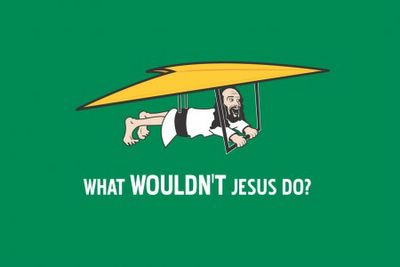
What wouldn't Jesus do?


Props to Socksy.

More about Christianstein

A couple of weeks back, Steve apparently did a sermon about 'Christianstein', based on a story from John Duckworth's Joan 'n' the Whale. John responded with a story about Emergent Christianstein.

Basically, the story of Christianstein is that a mad scientist tries to build the perfect specemin of a Christian, incorporating everything from courage and patience to daily Bible-reading and cultural relevance. He ends up creating a monster, because he forgets to include any love.

Just like Mary Shelley's Frankenstein (a.k.a. The Modern Prometheus), 'Christianstein' reminds me that we don't really know what's best for us. We try to become like God by stuffing around with people's genes, or by trying to shape ourslves and other people into what we think people should be like. What do we know? We forget about the most important thing, love.

Capitalist Megaquest

That^'s what Trav said the game we ran in Warrnambool on Friday night was called.

We (me, Trav and Dale) were supposed to be going down to Warrnambool to visit a kids club that is run by one of the churches there, and see if any of the leaders were interested in being involved with the Scripture Union mission in Warrnambool. It turned out that a number of their key leaders weren't going to make it that night, so they asked us to run the program, because Trav is a childrens ministry expert.

In Capitalist Megaquest the group is divided into a number of different countries. About forty kids turned up, so there were three countries, one in the sanctuary, one in the foyer, and one in a hall out the back.
At the start of the game, each country has to elect a Prime Minister. Everyone else gets assigned a job.

Prime Minister
The PM has to have meetings with the other PMs, where they have to sign forms. They also get interviewed on the news a lot and get paid more than anyone else.

Junk Salespeople
The Junk Salespeople have a table full of junk which they get to sell to people. They can also buy things from other people and try to resell it at a higher price.

McFood Salespeople
These people sell junk food.

Builders
The builders build houses from cards, and then tries to sell them to people.

Doctor
Every now and then me and Trav and Dale would go and tell someone they were sick or injured, so they had to go to the doctor. In the country I was looking after (Victoria, in the hall out the back) the whenever someone had to go to the doctor, she'd ask for all their forks (we used plastic forks for currency) or she wouldn't operate, and they would die, in which case she would get all their forks anyway.

Shoe Salespeople
These people had to sell shoes. Except we didn't give them any shoes. So they either had to sell their own shoes, or buy other peoples shoes off them and then resell them for more.

We also had a number of other roles that were carried out by leaders:
Good News/Bad News People
I was the Good News/Bad News Person in Victoria, Trav was was in Tasmania and Dale was in Queensland. We had to go and tell people they had suffered an injury or illness, or had won the lottery, et cetera.

Gaoler
People who stole things, or didn't pay attention to the news, or threatened other people got sent to the gaol (a store room). The gaoler lectured them about what they had done, and made sure they didn't escape until they'd done their time. The PMs of Victoria and Queensland both spent a lot of time in gaol.

Banker
At the end of each day (I think they went for about twelve minutes) everyone went to the bank (the creche) to get their pay. One of the kids from Victoria didn't want a job, so she was on the dole.

Eventually, most fo the kids just started stealing off each other. At one stage more than half the population of Victoria was in gaol for stealing. A number of times one country invaded another country and looted all their shops.

At the end of the game we took them all into the sanctuary and Trav tried to get them to think about whether it's really worth it trying to get lots of money and lots of stuff, but they were to busy trying to steal each other's forks.

Viva la capitalism!

We have a new housemate, at least for a while. Kimberly moved in last night. This is good not only because Kimberly is a nice person, but also because it means I have to pay less rent and can get more stuff and come closer to realising my capitalist dreams!

Tuesday, May 10, 2005

How cool is this?

...the Prophet, may Allah's peace and blessings be upon him, had a slightly different attitude towards Christians. He let the visiting Christians of Najran hold their Christian service at the mosque.
-Umm Yasmin, 'How Far from the Prophet Can an Islamic State Get?', Dervish

Backyard Camp

Tab has been on Desert Camp. Saturday night I had my own survival camp in the backyard.

John dropped me off at our hosue at about 1 am. We (me, John and Kelly) had been to visit John's friend's church in Geelong. I realised when I got to the door that I couldn't find my keys, and Alt Tab was out.

There were no clouds, so it was extremely cold, even though it had been a warm day.

Unfortunatley I couldn't break in. I've broken in before by taking the screen off the kitchen window and opening it, but that time it wasn't closed properly.

Luckily I had left my stereo outside, so I put Triple J on, and listened to Dave MCCormack (Dave Callan was on holidays) play some ... interesting ... and quite good music on The Graveyard Shift.

I found a couple of ways to keep warm, but neither of them were very good. One was to cup my hands around the lightbulb in the laundry (our laundry is seperate to the rest of the house). The other way was to put my hands in the steam that came out of the hot water system when it heated up. However, neither of these methods of getting warm was particularly good.

So I decided to make a fire. I found an old bowl in the laundry, and there were a lot of dead leaves around, so I put a heap of dead leaves and some bank receipts from my wallet in the bowl and used my lighter to start a fire in the bowl. This was quite good, but I had to keep relighting it, because there wasn't any decent fuel, only leaves and paper and cardboard. Because I kept having to use my lighter again and again, and sometimes it took some time to light, the lighter got very hot, and the plastic bits began to melt, until it was no longer a lighter, in that it could not be used to light stuff.

Alt Tab got back at about 5 am (she'd been at 21 Arms) and I had a hot bath.

Monday, May 09, 2005

Big Brother

The new season of Big Brother started last night. I know this because my housemate was watching it. She says she's sucked in.

One reason I don't like Big Brother, is because I think it is an example of what 1984, the source of the original Big Brother, warns us about.

In 1984, The Party enforce the use of Newspeak, a simplified version English, in which the vocabulary is always being reduced. The Party's aim in enfocring the use of Newspeak is to make it impossible for people to express or imagine dissent.

In a similar way, Big Brother is resulting in the simplification of vocabulary and meaning. It is making it harder to communicate the ideas presented in 1984. While the phrase 'Big Brother is watching you,' was once widely understood as a reference to a book about totalitarian society, now a lot of people understand it only as reference to a television show where heaps of people are locked in a house together and are on camera twenty-four hours a day because they want to win lots of money.

Friday, May 06, 2005

Unity

Tuesday night we satrted watching this documentary about the spiritual, environmental and socio-political revival in Fiji. This all happened after the churches of Fiji became willing to humble themselves before God in desperate prayer, and to cooperate with each other rather than to compete.

While we were discussing what we'd seen, we felt that we should do something to try and build better relationships between the churches in Ballarat. We're praying about that this week. Next Tuesday we're going to finish watching the doco, and then talk some more about this idea.

Tuesday, May 03, 2005

The Out of Bounds Church?


Darren has written an interesting response/summary of Steve Taylor's The Out of Bounds Church?

Salvation

Yesterday, in my Fantasy tutorial, we were talking about fairy tales, particularly Cinderella and Beauty and the Beast. The tutor asked us what people want to be saved from these days. One think I suggested was alienation. The tutor reckoned meaninglessness. What do you think?

Monday, May 02, 2005

Jesus Christ Superstar


Watched the 2000 version of Jesus Christ Superstar on the weekend.
I'd always been told (by Christians) that this production was blasphemous, but no-one would ever explain why.
I think I understand why now, but I'm not sure that I agree.

Jesus is portrayed as being very human, rather than hovering one foot above the ground. He gets scared. He finds it hard to lead his followers. He wonders if he really is just a very naughty boy. I'm not surprised that a lot of Christians find this offensive, but I'm not sure it's necessarily blasphemous.

I think the display of affection between Jesus and Mary Magdalene (and his other followers) would also make a lot of Christians uncomfortable. I realise that there isn't any scriptural evidence for a romantic relationship between Jesus and Mary, but I'm not sure why this is so offensive. I think the director is suggesting that it might be one reason why Jesus' disciples were angry Mary Magdalene when she annointed Jesus, washed his feet with her hair, et cetera. (John 12:1-11) (Please tell me if this is incoherrent and I'll rewrite it.)

Lastly, when the production first went to America, a lot of conventional churches were concerned about the Jesus People (aka Jesus Movement, Jesus Freaks), a movement of hippies who wanted to follow the teaching's of Jesus. So they would've been pretty upset to hear about a play where Jesus and his disciples are portrayed as hippies.

Also, Alt Tab noticed that one of Jesus' followers is also on Queer as Folk, and I think there has been a Zoo TV influence.