Showing posts with label scripture. Show all posts

Friday, November 28, 2008

Slavery

Started reading the Book of Revelation, alongside Unveiling Empire, in preparation for a workshop I'll be running for NCYC in January.

The revelation of Jesus Christ, which God gave him to show his servants [or slaves] what must soon take place; he made it known by sending his angel to his servant [or slave] John, who testified to the word of God and to the testimony of Jesus Christ, even to all that he saw.
(Revelation 1:1-2)
Thinking about what it means for Christians living in the Roman Empire around 100 AD to identify as God's slaves. We know that some of the early church were owned as slaves, and I wonder what their masters would have thought of the idea that their slaves now belonged to God? If you're a slave to God, does that mean you're free to do God's work, rather than your master's work? And each Christian is God's slave, does that mean they're all equal?

Wednesday, June 11, 2008

Sacred Space at SYG

So I stayed up all night on Thursday working on Sacred Space for State Youth Games. A lot of it was writing reflections and stuff.

At about 1pm Phil and Leanne from The Cave came and picked me up. This is how packed their car was with all our stuff:

It might have been about 4pm or something when we got to Lardner Park (near Warragul) where SYG is held. Age (from morepraxis) got there not long after us. These are some pictures I took while we were setting up:

I stayed up until about midnight on the Friday setting up. (So I was awake from 7am Thursday till 1am Saturday!)
This is a beetle I found on the outside of my tent when I got up at about midday on Saturday:

This is where we had our tents:

I spent most of Saturday afternoon finishing off the art installation.


This is Phil and Age being hippies:

These are some youths being youthful:

This is part of Phil's garden cross:

This is my computer, gradually disintegrating:


My art installation was about two parables, the parable of the sower (Mark 4) and the parable of the vine in Babylon (Ezekiel 17).

I had four piles of different soil (to represent the four places where the sower plants his seeds), which I'd planted vegetables in. (Celery, broccoli, onions, leeks and lettuce.)

This is what I had written for the soil reflections:

In the fourth chapter of Mark's Gospel, Jesus tell his followers about a farmer trying to plant seeds in strange places, where they are extremely unlikely to grow. He tells his closest friends that the seeds are like God's word.

It seems there are a lot of things about the world we live in that make it difficult for God's word to grow in our lives...
'Some seeds fell on the path, and the birds came and ate them up. When they hear the word, Satan immediately comes and and takes away the word that is sown in them.'
(verses 4 + 15)

Fill your hand with gravel for a moment. Can you think of many plants that would survive trying to grow on a gravel path? Why would a farmer plant seeds in such a place?
Do you know anyone whose doing it really tough, struggling to grow in a hostile environment - maybe getting eaten up a bit? Take some time to pray for them. If you like you can write down their name and plant it in the gravel, as a symbol of your prayer.
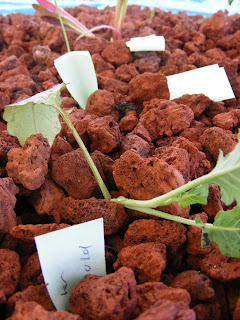
'Other seeds fell on rocky ground, where they did not have much soil, and they sprang up quickly, since they had no depth of soil. And when the sun rose, they were scorched; and since they had no roots, they withered away.
When they hear the word, they immediately receive it with joy. But they have no root, and endure only for a while. When trouble or persecution arises on account of the word, immediately they fall away.'
(verses 5, 6, 16 + 17)

Take a handfull of this rocky soil for a moment.
Do you know anyone who doesn't have much strong roots? Perhaps someone who's having a hard time finding stability or security? Take a rock, and carry it in you pocket as a reminder to pray for that person. If you like you can write down their name and plant it in the rocky soil, as a symbol of your prayer.
'Other seeds fell among thorns, and the thorns grew up and choked them, and they didn't produce any food. These are the ones who hear the word, but the cares of the world and the lures of wealth, and the desire for other things come in and choke the word, and it produces nothing.'
(verses 7, 18 + 19)

Touch the spikes of the thorns, and feel their sharpness.
Do you know anyone whose spiritual journey is being choked? Perhaps by economic, social or family pressures? Perhaps by something else? Take a moment to pray for them. If you like you can write down their name and plant it in the rocky soil, as a symbol of your prayer.
'Other seeds fell into good soil and brought forth grain, growing up and increasing and yielding thirty and sixty and a hundredfold. They hear the word and accept it and bear fruit, thirty and sixty and a hundredfold.'
(verses 8 + 20)

Take a handfull of the good soil for a moment.
Even though the farmer has to plant seeds in bad places, it seems there are still some places where crops can grow really well, and produce ridiculous amounts of food. It sounds like it might actually make enough money to buy a decent field, so the farmer won't have to plant seeds on the footpath, or in rocks or thorns ever again.
Can you think of something good that is growing in your life at the moment? Take some time to thank God for that growth. You might like to write it down, and plant it in the good soil, as a symbol of your prayer.
Behind the four soils I also had a city built out of boxes, and covered with some photos by Zoriah (Age owns the royalties to the images) as well as some of my own city-themed photos. I had the vine that I built growing up one of the skyscrapers:

Unfortunately I didn't get many pictures of the vine when it was finished.
Here is the reflection for the vine:
What will this plant need if it is to grow up tall and strong? What will it need in order to produce fruit? What will it need just to survive? What kind of an environment is it growing in? Will it be able to get what it needs in this kind of environment?
What to you need to survive? What do you need to live a whole life? What do you depend on to provide what you need? Babylon? Egypt? The globalised economy? Krispy Kreme? Boost Juice? Facebook? Family? Friends? God? Can you depend on these things to sustain you in your environment?
We also did some Bible studies and had communion at Sacred Space. On Saturday night Age led a Bible study on the parable of the sower, looking at the economics in it. On Sunday night I led us in communion, and later on I led a Bible study on Paul's letter to Philemon, and how Paul messes around with power structures in his letter.
This is a picture of part of the campsite, which Mehrin took on Sunday night, from where we were camping:


I used a simplified version of the soils installation for staff prayers yesterday evening:

Monday, June 02, 2008

Sacred Space at SYG (work in progress)

The last few weeks I've been working on stuff for the Sacred Space at State Youth Games. Phil from The Cave and Age from morepraxis are working on stuff for it too. The theme for SYG this year is 'sustain', and I've been thinking about two parables, from Mark 4 and Ezekiel 17.
These are some pictures of what I've been doing:


(Thanks to Marcus for the barbed wire, and to Mehrin for helping me get stuff from Bunnings yesterday.)

Monday, January 28, 2008

Contemplation in Gembrook

On Thursday we went out to the Gembrook Retreat Centre with some of the Footscray mob. (We take people who come to lunch out there so they can get out of the city, and do a bit of work on the land.) We got there at about lunch time, and after we had lunch I facilitated some contemplative worship based around the first account of creation in the book of Genesis (1-2:3). Outside one of the huts I set up a number of stations with some things to help us contemplate the various parts of God's creation:

Light
In the beginning when God created the heavens and the earth, the earth was a formless void and darkness covered the face of the deep, while a wind from God swept over the face of the waters. Then God said, ‘Let there be light’; and there was light. And God saw that the light was good; and God separated the light from the darkness. God called the light Day, and the darkness he called Night. And there was evening and there was morning, the first day.
(Genesis 1:1-5)


'How does light travel through transparent bodies? Light travels through transparent bodies in straight lines only. ... We have explained this exhaustively in our Book of Optics. But let us now mention something to prove this convincingly: the fact that light travels in straight lines is clearly observed in the lights which enter into dark rooms through holes. ... the entering light will be clearly observable in the dust which fills the air.'
'I constantly sought knowledge and truth, and it became my belief that for gaining access to the effulgence and closeness to God, there is no better way than that of searching for truth and knowledge.'
(11th Century Persian scientist Ibn al Haytham - considered by many to be the first true scientist)
From the 17th Century onwards there was controversy about whether light was a particle or a wave. Apparently these days it seems a lot like light has the properties of a particle and of a wave. I find it pretty confusing. I wonder if maybe sometimes it helps to think of it as a particle and sometimes as a wave. Apparently light also behaves differently if it's being observed to how it behaves if it isn't being observed. If anyone gets wave-particle duality, can they please try to explain it below? Thanks.


People
Then God said, ‘Let us make humankind in our image, according to our likeness; and let them have dominion over the fish of the sea, and over the birds of the air, and over the cattle, and over all the wild animals of the earth, and over every creeping thing that creeps upon the earth.’
So God created humankind in his image,
in the image of God he created them;
male and female he created them.
God blessed them, and God said to them, ‘Be fruitful and multiply, and fill the earth and subdue it; and have dominion over the fish of the sea and over the birds of the air and over every living thing that moves upon the earth.’ God said, ‘See, I have given you every plant yielding seed that is upon the face of all the earth, and every tree with seed in its fruit; you shall have them for food. And to every beast of the earth, and to every bird of the air, and to everything that creeps on the earth, everything that has the breath of life, I have given every green plant for food.’ And it was so. God saw everything that he had made, and indeed, it was very good. And there was evening and there was morning, the sixth day.
(Genesis 1:26-31)
I've recently been reading Education for Critical Consciousness, a collection of essays by Brazilian educator Paulo Freire. Freire mainly worked with people who were poor and illiterate, many of them farmers.
Freire says that the thing that separates human beings from the rest of creation is that human beings are creative beings who are constantly altering the rest of reaction, through work.
What kind of a world is our work creating? What immediately comes to mind for me is the city, but I suppose the city (or a small town, or a retreat centre) is made up of lots of little alterations. Which of those alterations are yours? Do you have any other ideas? What work will you have to do to bring them into reality?
Paulo Freire also says that being denied the power to alter reality is dehumanising. Are there any ways that you and your friends are being denied the opportunity to participate in creation?
(Those are from a couple of the stations that I was happiest with.)

Afterwards Alisdair and Naomi facilitated some discussion around Jesus' seed parables in Mark's Gospel (4:1-8, 26-32). After reading them they got us to go and find a seed, and plant it somewhere. I got a piece of tomato (with seeds in it) from our lunch and fed it to one of the goats. So she's probably planted the seeds somewhere herself by now.

We talked afterwards about how we often interpret Jesus' parables as though they are spiritual - but in a way that's somehow separate from 'earthly' things. However, if Jesus is telling a story about people trying to grow crops in places where they're obviously not going to grow (eg. in the street) isn't it pretty significant that he's saying it in a place where a lot of people don't have anywhere to grow food because their own land has been bought up by rich landlords.

Sunday, September 30, 2007

With us or against us?


Last week we had four people staying with us at Urban Seed for Mission Exposure, which is a time for people to find out a bit about what we do, and the ideas behind what we do. We started off the week by each sharing a bit about our faith journies, particularly how different things have influenced how we see God, the world and our place within the world. We tend to end up with some fairly diverse ideas in the room, so I started off the sharing time with some thoughts on some things Jesus said:

Then some people brought to Jesus a man who was blind and could not talk because he had a demon. Jesus healed the man, so that he was able to talk and see.
The crowds were all amazed at what Jesus had done. 'Could he be the Son of David?' they asked.
When the Pharisees heard this, they replied, 'He drives out demons only because their ruler, the Devil, gives him power to do so.'
Jesus knew what they were thinking, and so he said to them, 'Any country that divides itself into groups which fight each other will not last very long. And any town or family that divides itself into groups which fight each other will fall apart. So if one group is fighting another in Satan's kingdom, this means that it is already divided into groups and will soon fall apart! You say that I drive out demons because the Devil gives me the power to do so. Well, then, who gives your followers the power to drive them out? What your own followers do proves that you are wrong! No, it is not the Devil, but God's Spirit, who gives me the power to drive out demons, which proves that the Kingdom of God has already come upon you.
'No one can break into a strong man's house and take away his belongings unless he first ties up the strong man; then he can plunder his house.
'Anyone who is not for me is really against me; anyone who does not help me gather is really scattering.'
(Matthew 12:22-30)

An argument broke out among the disciples as to which one of them was the greatest. Jesus knew what they were thinking, so he took a child, stood him by his side, and said to them, 'Whoever welcomes this child in my name, welcomes me; and whoever welcomes me, also welcomes the one who sent me. For the one who is least among you all is the greatest.'
John spoke up, 'Master, we saw a man driving out demons in your name, and we told him to stop, because he doesn't belong to our group.'
'Do not try to stop him,' Jesus said to him and to the other disciples, 'because whoever is not against you is for you.'
(Luke 9:46-50)
This is a bit confusing, because it seems like Matthew has Jesus saying that people who aren't part of your group are against you, and as though Luke has Jesus saying that people from other groups are really trying to do the same things as us.
In 2001, after the terrorist attacks in the United States, George Bush paraphrased Jesus, saying to the nations of the world, 'Either you are with us, or you are with the terrorists.'
However, in both of these stories Jesus is actually working against division. In Matthew's gospel Jesus tells those who are trying to demonise him that he's doing the same thing as them, and that his power comes from the same place.
In Luke's story, Jesus' disciples are arguing about who's the best, and straight afterwards they're wanting to stop people who aren't part of their group from doing good things. Jesus tells them that just because someone is from a different group doesn't mean we're in competition with them.

Wednesday, July 25, 2007

Training week

This week we're taking a week off from running Credo, so that we can do some training and team-building stuff.
On Monday we went down to Sue's place at Ocean Grove, and in the afternoon we shared a bit about our faith journies. I started off the session by sharing a bit about two passages from the gospels, where Jesus says,

'Anyone who is not for me is really against me,'
(Matthew 12:22-30)
and,
'whoever is not against you is for you.'
(Luke 9:46-50)
I find it a bit confusing that Luke and Matthew put it different ways, but in both cases it seems like he's got a problem with people demonising people who aren't part of their group. (I think that's important to remember when we share about our experiences of different spiritual movements and ideas.)
In the afternoon some of us went to Norlane to visit the community dinner that the Seeds folk in Norlane have been running.
Took this from the van on the way home:

Today we were supposed to be doing overdose response training, but the person who was supposed to be running it had to pull out, so we'll be doing it some tiem in the next few weeks. Thursday and Friday we're doing mental health first aid.

Sunday, July 22, 2007

Wer da luv?


I saw this a while back, in La Trobe Lane (Chinatown) but was fairly hestitant to share it anywhere, thinking it was a bit shallow and clichéd. I wonder if that's actually an indication of the shallowness of my understanding of love?

Love is patient, love is kind. It does not envy, it does not boast, it is not proud. It is not rude, it is not self-seeking, it is not easily angered, it keeps no record of wrongs. Love does not delight in evil but rejoices with the truth. It always protects, always trusts, always hopes, always perseveres.
(1 Corinthians 13:4-7)

Wednesday, June 20, 2007

'Happiness is in your choices'

I've been reading Colossians Remixed, a book that attempts to interpret Paul's letter to the church of Colossae in it's original context, and in the context of postmodernity and the global economy.
Early on in the book the authors write about how postmodernity and globalisation work together despite seeming incompatible, because both see people primarily as 'units of consumption for whom choice is the defining characteristic.' (p32)
I came across this advertisment the other day, and I think it demonstrates this idea quite well:

Monday, May 28, 2007

'Love your enemies'

Just been reading Jesus' famous sermon on the mount, as preparation for tomorrow's vigil. This bit in particular stood out to me:

"You have heard that it was said, 'Love your neighbor and hate your enemy.' But I tell you: Love your enemies and pray for those who persecute you, that you may be sons [and daughters] of your Father in heaven. He causes his sun to rise on the evil and the good, and sends rain on the righteous and the unrighteous. If you love those who love you, what reward will you get? Are not even the tax collectors doing that? And if you greet only your brothers [and sisters], what are you doing more than others? Do not even pagans do that? Be perfect, therefore, as your heavenly Father is perfect.
(Matthew 5:43-48)
I'm thinking about the fact that if you hate your enemy then it's pretty difficult to have any hope for tranformation or reconciliation. It often means you can end up seeing them as being completely evil and yourself as being completely righteous in hating them. (That's called scapegoating.) We noticed that going on at the G20 last year, where some protesters were saying that if was fine to use violence against the police, because they weren't human anymore.

Sunday, May 20, 2007

Credo retreat

So Friday night at about 10:30 Ben picked me up from work and we headed out to retreat, stopping in Ringwood to have pizza for second dinner, and driving through the Black Spur, which wasn't too scary because we were listening to The Clash, and they're scarier. I think we arrived around 1am.
Saturday morning Luke invented another new game, which combined Rusk with Pool. He called it Pusk. You had to try and knock over everyone else's soldiers with the pool ball.


Saturday afternoon it was raining an awful lot, but a fair few people still decided to go for a bushwalk, and ended up all covered in leeches.
Saturday night we had karaoke.

This morning we had a church gathering, based around the story about Jesus healing the man who had a legion of demons (Mark 5).

One of the things we noticed about the story is that when Jesus heals the guy, his neighbours, who used to try and chain him up, are upset and scared. It's as though they were more comfortable with him as a possessed madman. We finished up church by playing Queen's song 'I've Got to Break Free'. (While me and Tomsy were planning the church gathering it started playing on the radio, so we decided to use it!)
We got the owners of the camp to take a group photo before we left this afternoon: