Showing posts with label mission. Show all posts

Thursday, October 20, 2005

Theology and culture

An old(er) post by Fernando from his Desk:

...the most common response is either naive acceptance, or reactionary rejection of culture. By contrast, we should approach our culture open both to find what is good and reject that which is not, on the basis of familiarity with Christ and with the practice of faith...
Read the whole post here. Also check out Matt Stone's post about Daniel and how we measure missional success.

Wednesday, August 24, 2005

Urgent work

Jesus went through all the towns and villages, teaching in their synagogues, preaching the good news of the kingdom and healing every disease and sickness. When he saw the crowds, he had compassion on them, because they were harassed and helpless, like sheep without a shepherd. Then he said to his disciples, 'The harvest is plentiful but the workers are few. Ask the Lord of the harvest, therefore, to send out workers into his harvest field.'
(Matthew 9:35-38)
Can't remember where I heard I read this – it was either in Shaping of Things to Come (which I don’t have a copy of anymore) or at one of the Forge intensive open nights late last year (and I don’t usually take notes) – but the First Century Palestinian context is important in understanding this parable.
These days, because of genetic engineering and pesticides and stuff, farmers don’t have to be as on the ball about when they harvest a crop. When Jesus was around they didn’t have all that, so crops had to be harvested at exactly the right time. If they weren't, they’d get eaten up by pests, or they’d just go bad. So when Jesus says that there aren’t many workers, that’s an urgent problem.

Friday, February 25, 2005

Valuing every decision

Tonight I'm going down to Montrose, in outer-eastern Melbourne, for the Warrnambool Mission core leaders' weekend. Trav's asked me if I could talk about valuing every decision a person make that brings them closer to God. So here is some of the stuff I'll be talking about.

A farm with a fence
A lot of the time we look at God's Kingdom in terms of who's in and who's out. We work out whether someone's in or out by whether or not they display certain traits that we consider to be Christian. This is kind of like your generic farm, where the farmer keeps the animals together by putting a fence around them.
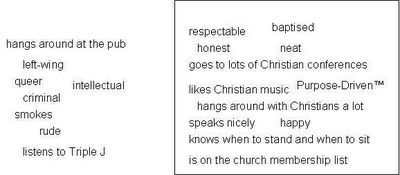

This point of view has a significant effect on the way to we do mission. It means that we focus almost entirely on getting people who aren't Christians to pray the sinner's prayer (which isn't actually in the Bible).

A farm with a well
Out in the desert, the farms are so big that there isn't much point in having fences. Instead, to keep the animals wandering off, the farmer digs a deep well. The animals will stay near the well, so that they don’t die of thirst.
We can also look at God's Kingdom like this. Rather than looking at each person as being inside or outside the boundaries, we could look at how close each person is to the centre (God), and whether they're moving closer or further away from him. If take this point of view, everyone is potentially part of God's Kingdom, and nobody is excluded.


Every decision is important
Instead of focusing on just getting a person to pray the sinner's prayer we should be concerned with each decision that brings a person closer to God.
The scale below shows some of the stages leading up to a person becoming a Christian. But the journey towards God doesn't stop with the person being reborn.


This scale is also helpful. It shows that a person needs to have more than just knowledge of the gospel to be converted. They also need to have a positive attitude about it.

The person in the bottom left section has little knowledge of the gospel, but still has a negative attitude toward it. The person in the bottom right section thinks the gospel is good, but doesn't know very much about it. The person in the top left section knows heaps about the gospel, and doesn't like it. The person in the top right corner is well-informed about the gospel, and thinks it's good.

So, for effective mission, we don't just need to get the story across, but to make it look attractive. If we do or say something that doesn't make the story much clearer, but makes it seem good, that is still evangelism.

If we can work out roughly where someone is on these scales, then maybe we can work out what is needed to get them to the next stage. We have to take into account what knowledge they already have of Christianity, and what attitudes they have towards it. It might not be appropriate at this stage to try and get them to commit to Christianity. First they need to make a heap of other decisions, and they'll have to keep making important decisions after they become a Christian.

Sources:
'Gray's the color of life', Gospelcom
The Shaping of Things to Come, Michael Frost and Alan Hirsch, pp 47-48
Some stuff Naomi Swindon talked to us about at core leaders' weekend last year

Monday, February 21, 2005

The shape of church + Spiritual stuff

A few of us been thinking, talking, and experimenting about how we can be the church amongst people who aren't Christians, and one thing we tried Tuesday night was having a party. As far as I know, those of us who did mix with people who weren't Christians, all got into conversations about spirituality with at least one person during the night.

One thing me and Alt Tab were talking about the other day was, what if, for our church gathering, we just opened up our house once a week so that our friends, whether they're Christian or not, can come and interact?

I think that this kind of a gathering would not have been good for someone like I was a few years back, when I was a new Christian, because my Christianity wasn't something I thought about a lot (mostly just when I was around other Christians, participating in offical church programs). I didn't see every activity or place as spiritual. Therefore, if I was in a place or participating in an activity which I didn't consider spiritual, it was very unlikley that I would think of or talk about spiritual issues. If I went to a party, or just over to a mates place, I wouldn't see that as a missional opportunity, or as having any spiritual relevance.

My thinking has changed a lot now. Because I see everything as spiritual, I'm more open to God communicating through things that have traditionally been considered secular, or everyday. Because of this realisation, I'm far more likely to contemplate the spiritual in an everyday, 'secular' setting. These days I probably don't go ten minutes without thinking about God.

So I don't think any longer that there would be a problem with the church gathering being very loosely structured. If God is a huge part of our lives, and we are open to hearing his voice through all sorts of ordinary stuff, then I don't think the it would be a much of a problem if the church gathering was as I described earlier.

Sorry if my posts are rambling a lot. I'm trying to sort out a lot of stuff in my head, and I want to have a record of my journey.

Thursday, February 17, 2005

House party

On Tuesday night we had a party at our house, to try and get our friends who are Christian mixing with our friends who aren't.
(A lot of them don't have any friends, or even co-workers, who aren't Christians.)
In some ways the party was really good and in other ways it was pretty disappointing. More than half the Christians who came along didn't mix with anyone they didn't know (so they only talked to other Christians) and left the party quite early. However, the Christians who were sociable got to know our other friends, and we all had some great conversations.
By about midnight, we ended up sitting in the lounge, mostly singing and passing Alt Tab's guitar around (those who could play). We ended the night by watching the video of Alt Tab and Kate's baptism - someone who hadn't been able to make it to the actual celebration wanted to see it. It was after 4am by the time I got to bed.

I'm thinking that in terms of getting the Christians who didn't mix to mix, we might need to take them individually to other people's parties, so that they won't know many people, and will have to interact with unfamiliar people.